This is planned work, so you can usually schedule it, and same-day appointments for inspections are available when we have room. If a pipe is actively leaking, shut off the main valve and call the 24/7 line. We can stop the leak first, and then talk about whether a repipe is the right next step.
How to tell your pipes are near the end
- Rust-colored or brown water that clears after the tap runs for a while.
- Low pressure at several fixtures, especially upstairs or the farthest tap.
- Repeated pinhole leaks or a second leak in the same line within a couple of years.
- Green or white crust on joints and visible flaking on pipe surfaces.
- Pipe that is gray, rough and threaded at the joints, which is typical of galvanized steel.
- Gray or black plastic pipe with metal or plastic crimp rings, which may be polybutylene.
Galvanized pipe: the common reason to repipe
Galvanized steel supply pipe is coated in zinc, and the coating wears away from the inside over decades. Rust and mineral scale narrow the opening, so pressure falls even when the pipe does not leak. A pipe that was 3/4 inch when new can be half that inside.
In the pre-1960 part of town (the first wave of homes west of Orchard Drive and east of Main Street), galvanized lines may still be in the walls if they were never replaced. A plumber can often tell from the basement or crawlspace, because galvanized is rigid, gray and threaded. If you see it, plan for replacement before it fails inside a wall.
Polybutylene: a general warning
Polybutylene was a gray or blue plastic pipe sold roughly from the late 1970s to 1995. It is general plumbing knowledge, not a North Salt Lake finding, that it became known for failures at fittings. Homes built in that window can have it, and so can additions from those years.
We cannot say whether any particular house has it without looking. A quick check of the main line near the water heater or meter shows the material. If it is polybutylene, plan the replacement before a leak forces it. Insurers sometimes ask about it, so ask yours.
Copper, PEX or CPVC: choosing the material
| Material | Strengths | Trade-offs |
|---|---|---|
| Copper | Long track record, handles heat, fire resistant | Costs more, can pinhole in aggressive water, more labor |
| PEX | Flexible, fewer fittings, quicker to run through walls | Not for sunlight exposure, fittings are the weak point |
| CPVC | Lower material cost, stiff, easy to work with | Can become brittle with age and heat, less forgiving to vibration |
No material is perfect for every house. The city’s 2024 water quality report lists total dissolved solids of 888 to 980 mg/L, a high mineral content, so ask us how that affects the choice between copper and plastics for your home. We will explain what fits your layout and budget rather than steer you to one product.
Whole-house or partial repiping
A whole-house repipe replaces all supply lines to every fixture. It makes sense when the pipe material is failing everywhere, such as galvanized or polybutylene throughout. A partial repipe replaces one branch, such as the kitchen and bath on one side, and works when the problem is limited.
A partial job is cheaper up front but can leave an old section that fails next. If your home has pipe of two different ages, ask for a camera or pressure test on the part you keep. We will tell you plainly if we think a partial repair will only postpone a bigger job.
Tired of patching pipes?
Call and tell us how many leaks you have had and what the pipes are made of. A plumber can talk through options.
What happens to your walls and ceilings
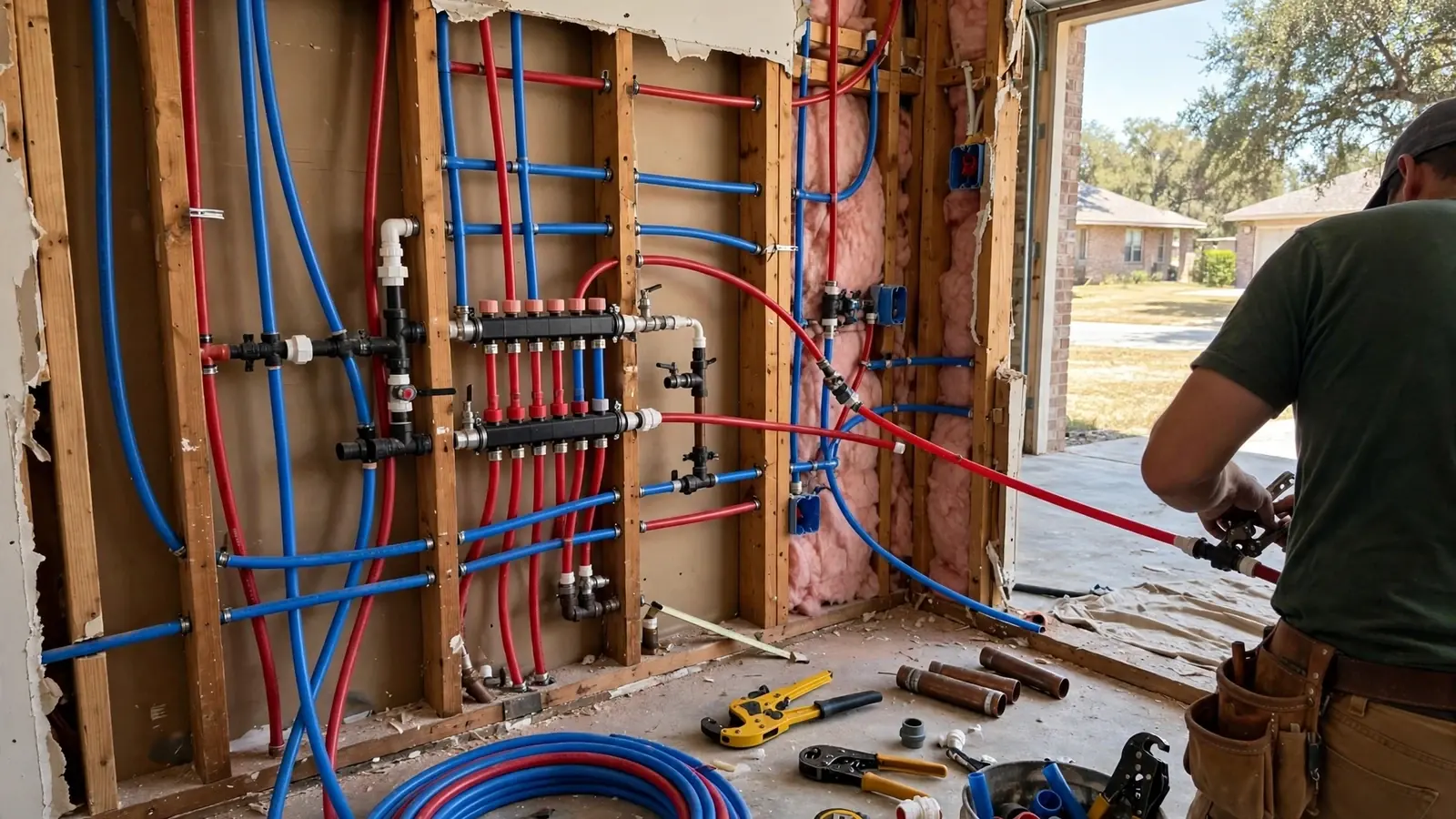
Repiping usually means opening drywall in a few places to run new lines. PEX can often be fished through existing walls, which reduces the number of openings. Copper and CPVC may need more access. Basements and crawlspaces help a lot, because the main runs sit in the joists, not behind finished walls.
Patching drywall and repainting are separate trades, and we will say what we leave for you. Water is off for part of the day, so plan for that.
Older west-side homes and Foxboro: what each is likely to need
Homes built between about 1910 and 1960 west of Orchard Drive may have galvanized supply, cast-iron or clay drains and a mix of repairs from different decades. For those, a repipe often comes with other repairs, and a look at the drains is worthwhile.
Foxboro, built from 2000 to 2010, is generally newer pipe, mostly PEX, CPVC or copper, so a full repipe is rare. A leak there is usually a failed fitting. Hillside homes built since about 1960 east of Orchard Drive fall between, and the pipe type varies house to house. You can see the material for yourself if you can reach a pipe in the basement.
Permits and the Building Department
Replacing supply piping needs a plumbing permit in North Salt Lake. The Building Department at 10 E Center Street issues permits through the City Inspect portal, typically with no plan review. The over-the-counter permit fee is $50.50, and inspections run Monday to Thursday.
Utah limits what homeowners may do themselves. Modifying existing piping falls outside the homeowner exemption, so check with the Building Department and DOPL. You can confirm any plumber’s license on the Utah DOPL lookup. The state-adopted plumbing code is the 2024 International Plumbing Code (IPC) from July 1, 2026.
What drives the price of a repipe
We give you a clear price before work starts. Here is what moves it:
- Number of fixtures and the size of the house.
- Pipe material you choose.
- How accessible the lines are, such as open basement versus finished walls.
- Whether a manifold or new shutoffs are added.
- Permit, inspection and the amount of drywall patching needed.
Homeowners insurance usually covers sudden and accidental water damage but not repiping done because of age. Ask your insurer, and if a leak has already caused damage, document it first. For a single failed section, burst pipe repair may be all you need.
A leaking pipe you cannot find
Before you commit to a repipe, confirm where the leaks are. A leak in one fitting does not mean every pipe is bad. Pressure testing and leak detection can show whether the problem is local or widespread, and that is often the difference between a repair and a full job.
Frequently asked questions
It depends on the size of the house and access. Many are done in a few days with the water off for part of each day. We give you a schedule after we inspect.
It was sold roughly from the late 1970s to 1995 and has a record of failures at fittings. That is general plumbing knowledge. If your house has it, plan to replace it.
Usually not, though water is off for stretches. Some people stay with family for a day if the work is heavy.
Yes, PEX approved for potable water is widely used. We can talk through the type and fittings for your house.
Yes. Replacing supply piping needs a plumbing permit from the Building Department at 10 E Center Street, and we pull it and arrange the inspection.
Utah limits what homeowners may do, and modifying existing piping is not covered by the exemption. Check with the Building Department and DOPL before starting.
Yes, when the rest of the pipe is sound. We test the remaining lines first and tell you if a partial job is reasonable.
Yes, including Centerville. Call the same number and give the address.