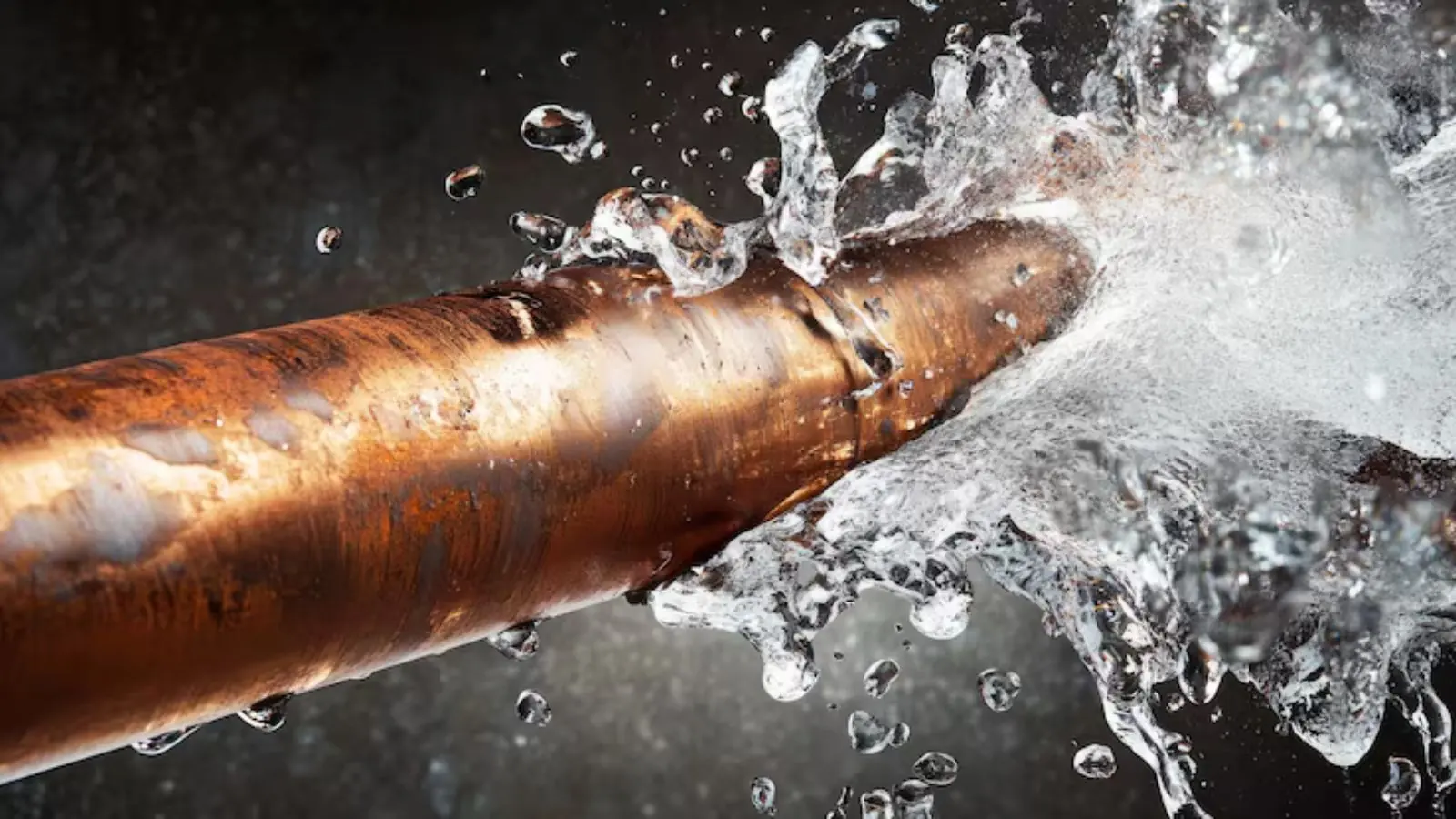
If a pipe has burst, close the main valve, switch off power to wet rooms at the breaker and open the lowest faucet to drain pressure. Then call. Same-day appointments are available when a crack is small and contained, and nights and weekends are covered for anything that is flooding.
Stop the flood first: shutting off the water
If you cannot find the main or it will not turn, call Public Works at 801-335-8726 (after hours 801-560-3718) about the city shutoff, and call us.
Find the main valve
It is usually where the line enters the house, in a basement, utility room or crawlspace, and sometimes outside near the meter.
Turn it clockwise
A wheel handle turns right until it stops. A lever handle sits across the pipe when closed.
Drain the system
Open the lowest tap in the house and a high one to let the remaining water and pressure out.
Kill the water heater
Turn off the gas control or the breaker so the tank does not heat while empty.
Frozen pipes and thawing safely
Winter in North Salt Lake is serious enough that the city’s own design criteria use 8 F as the winter design temperature and 30 inches as the footing frost depth. That tells you the outdoor temperature can freeze a pipe that sits in an unheated wall, garage or crawlspace long before the ground does. Pipes along exterior walls and in vented crawlspaces are the usual victims.
If a faucet gives a trickle or nothing at all in a cold snap, a pipe may be frozen but not yet burst. Open the tap, then warm the pipe gently with a hair dryer on low, working from the faucet toward the frozen section. Never use an open flame, a torch or a propane heater, since these ignite framing and can overheat a pipe until it splits.
If you see frost on the pipe, a bulge or a crack, stop thawing and shut off the main. A pipe that froze may already have split, and the leak shows only when it thaws. A plumber thaws the section safely, checks for splits and replaces anything damaged.
Cracked or broken pipe repair
A cracked pipe can be a slow weep or a spray, and the cause is usually freezing, corrosion, a loose fitting or movement in the ground. Cracks from freezing often run along the pipe lengthwise, while corrosion leaves pinholes and green or white crust at a joint.
The repair depends on the material and where it sits. Short damaged sections are cut out and replaced with new pipe and fittings. If the same line has failed twice, or several spots are corroded, a larger repiping job usually costs less than repeated patches. If you are not sure where the water is coming from, our leak detection team can locate it before anyone cuts a wall.
Copper pipe repair
Copper is common in homes built from the 1960s onward, and it fails in recognizable ways. Freezing splits it. Age and mineral-rich water can wear thin spots, and a soldered joint can let go.
For a clean split we cut out the damaged length and sweat in a new section with fittings, or use push-connect fittings where heat is risky. Pinholes in several places are a warning that the whole run is wearing out. We will tell you honestly whether to patch or replace.
Drain pipe repair
Not every burst pipe carries clean water. A cracked drain line leaks wastewater into the wall or crawlspace, often with a sewer smell and a stain that returns after laundry or a bath.
Cast iron, clay and plastic drains each break differently, so a camera or a water test helps find the damage. We replace cracked sections of cast iron and plastic with new pipe. A failing main drain that runs under the yard is covered by our sewer line repair page.
Which pipe broke and why
| Material | Typical failure | Common cause |
|---|---|---|
| Copper | Split along the length, pinholes at joints | Freezing, age, mineral buildup |
| PEX | Fitting leak, split near a bend | Freezing, bad crimp, UV damage |
| Galvanized steel | Rust-through, low flow, leaks at threads | Age of the pipe |
| Cast iron drain | Crack, rusted joint, collapsed section | Age, settling, corrosion |
| PVC or ABS drain | Cracked joint, hole from impact | Movement, poor glue joint |
Water pouring from a pipe?
Call the 24/7 line, tell us where the water is coming from and whether the main is closed, and a plumber will be dispatched.
What not to do after a pipe bursts
- Do not use an open flame or torch to thaw a pipe.
- Do not stand in water if outlets or appliances are underwater, and shut the power off at the panel only if the panel is dry and reachable.
- Do not wait to see if the leak stops. A burst pipe does not seal itself.
- Do not wrap a split with tape and call it fixed. Tape holds for minutes, not days.
- Do not run the dishwasher, washer or shower to "use up" water.
- Do not throw away damaged materials until you have photographed them.
Documenting damage for your insurer
Photograph the burst pipe, the water line on the walls and every affected item before cleanup. Keep any damaged section of pipe if you can. Write down when you noticed the leak and when the water was shut off.
Homeowners policies typically cover sudden and accidental water damage, such as a pipe that freezes and bursts, but not wear and maintenance problems. Ask your insurer what applies to you. We provide a written description of the repair on request.
A seasonal pattern in North Salt Lake homes
Hillside homes east of Orchard Drive often have long exterior-wall runs, and the first wave of homes west of Orchard Drive and east of Main Street, built between about 1910 and 1960, can carry older galvanized or copper lines. Neither is necessarily weak, but both are worth insulating before the first hard freeze. If a line froze once, it will freeze again, so ask the plumber to reroute or insulate it during the repair.
What shapes the price of a burst pipe repair
We give you a clear price before work starts. These are the main factors:
- Whether the pipe is exposed or sealed inside a wall or ceiling.
- Pipe material, size and how many feet are damaged.
- How many fittings and valves need replacing.
- Whether the repair is a thaw and patch or a reroute.
- Whether a permit is needed, since replacing piping may require one from the Building Department.
Permits are issued through the city’s online portal, with plumbing permits typically not needing plan review, and the Building Department is at 10 E Center Street.
Plumbing code and your repair
Replacement piping must meet the plumbing code Utah enforces, which is the 2024 International Plumbing Code (IPC) from July 1, 2026. That affects pipe material, support spacing and how a section is joined. A temporary clamp or push-fit coupling may stop the flood tonight, and the plumber will tell you when a permanent code-compliant repair should follow.
Frequently asked questions
Yes. The line is open 24/7 for flooding pipes, including holidays. Shut the main, then call and tell the dispatcher where the water is coming from so the plumber arrives with the right pipe and fittings.
Water stains, a drip when the pipe thaws, a bulge in the pipe or a sudden drop in pressure can all mean a split. If in doubt, shut off the main and let a plumber check the line.
You can use gentle warmth, such as a hair dryer or warm towels, with the tap open. Never use a flame. If the pipe is inside a wall or you cannot reach it, call a plumber.
Sometimes. If the leak is behind drywall we find it first with moisture mapping and cut a small access hole. Patching and painting are separate trades, and we will say what is left for you.
Replacing or rerouting piping may need one. Plumbing permits in North Salt Lake go through the Building Department at 10 E Center Street, and we handle permits when they apply. Utah limits what homeowners may do themselves, so check with the department.
Often for sudden damage, less so for slow wear. Ask your insurer before repairs, and keep photos and the damaged pipe.
Yes, including Woods Cross. Call the same line and say the address.
Possibly. If the pipe fed the tank, the heater can be damaged or leaking too. See our water heater repair page.