If the bowl is rising toward the rim, do not flush again. Lift the tank lid and push the flapper down, or turn the shutoff valve at the wall clockwise. Then call us. Nights, weekends and holidays are covered for overflows, and same-day appointments are available for slower problems such as a rocking seat or a constant hiss.
The bowl is rising and the floor is next
An overflowing toilet has two possible causes, and the fix depends on which. A clog in the toilet’s own trap or drain arm backs the bowl up, while a blockage deeper in the line also makes the tub or floor drain gurgle. The first is a closet auger job. The second is a line problem for our drain cleaning team.
Close the shutoff valve first. It sits on the wall or floor behind the toilet, with a small oval handle. If the valve is stuck, lift the tank float or tie the fill valve arm up with a string, so water stops entering the tank. Towels at the base buy time, and a wet vacuum clears floor water quickly.
Do not pour chemical cleaner into a full bowl. The liquid sits in standing water and splashes when you plunge, and it can damage the porcelain seal and rubber parts. A flange plunger, not a cup plunger, is the right tool for a toilet. Push slowly, then pull hard to break the clog free.
Leaks at the base and what they mean
Water around the foot of a toilet is a seal problem more often than a crack. A wax ring, or a modern wax-free seal, sits between the toilet outlet and the floor flange. When the toilet rocks, the seal breaks and sewer water seeps out. You may notice a smell, a stained floor or soft flooring near the base.
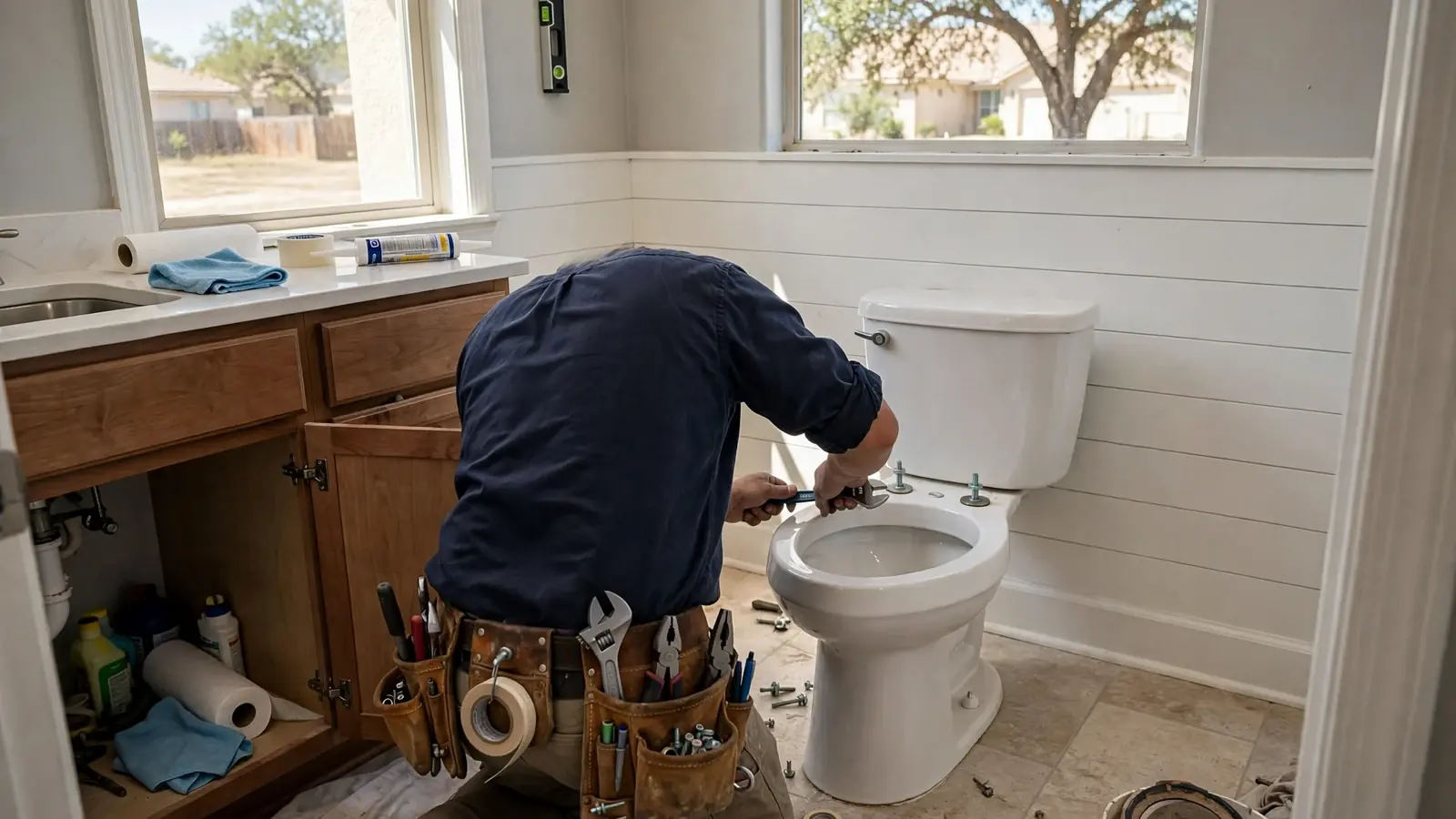
A leak at the base needs more than caulk. We lift the toilet, inspect the flange and the subfloor, replace the seal and reset the bowl on fresh closet bolts. If the floor underneath has rotted, we say so and explain what repair is needed before the toilet goes back. Waiting makes the floor worse. A leak can run for months before it shows on the ceiling below.
A wobbling toilet and a damaged flange
The flange is the ring that bolts the toilet to the floor and connects it to the drain. A cracked or corroded flange cannot hold the bolts, so the toilet shifts and the seal breaks again. A flange set too low, below the finished floor after a tile upgrade, causes the same trouble. Repair kits and spacers exist for some cases, and a new flange is needed for others.
We check the flange height, material and condition each time we pull a toilet. Cast iron flanges rust and PVC flanges crack, and either one is repairable. Installing a toilet for the first time or altering the drain piping may need a permit, and Utah limits what homeowners may do themselves, so check with the Building Department and DOPL.
What to do while you wait
- Close the shutoff valve behind the toilet by turning it clockwise until it stops.
- Stop flushing and tell everyone in the house, including children and guests.
- Lift the tank lid and make sure the flapper is seated, or tie up the float.
- Lay towels around the base and use a wet vacuum on standing water.
- Keep pets and children away if the water is from a sewer backup.
- If the bathtub or floor drain is also bubbling, stop running water anywhere in the house.
- Take a photo of damage in case you need to talk to your insurer.
Running, hissing and weak flushes
Not every toilet problem is a flood. These are the common nuisance faults and what usually causes them.
| Symptom | Usual cause | Typical repair |
|---|---|---|
| Runs after flushing | Worn flapper or chain too tight | Replace flapper, adjust chain |
| Hisses or refills slowly | Failing fill valve | Replace fill valve |
| Weak flush | Clogged rim jets or low tank water | Clean jets, set water level |
| Phantom refill every few minutes | Tiny flapper leak | New flapper, test with dye |
| Water at the supply connection | Worn supply line or washer | New braided supply line |
| Tank sweating | Cold water on warm air | Insulated liner or mixing valve |
A running toilet is worth fixing quickly. Wasted water adds up on the utility bill and wears on the fill valve. It also hides real leaks.
Toilet flooding the bathroom?
Call the 24/7 line. We will walk you through closing the supply valve while a plumber heads your way.
Tank parts, supply lines and the shutoff valve
The fill valve controls water entering the tank, the flapper seals the tank to the bowl, and the supply line links the shutoff valve to the tank. Each part is replaceable, and a full rebuild of the guts costs far less than a new toilet.
A supply line that looks old, or a valve that does not turn, should be changed during any visit. A seized shutoff valve is a hazard because it is the first thing you reach for during a leak.
Replacing or installing a toilet
Sometimes repair is not the best path. A cracked bowl or tank, an old unit that flushes weakly and rocks on a failing floor, or a model you want to modernize are all reasons to replace. We install new toilets, replace old ones and put in toilets in newly finished bathrooms.
Choices are simpler than the shelf suggests. Measure the rough-in, the distance from the wall to the center of the drain, which is commonly 12 inches. Choose round or elongated bowl, standard or comfort height, and decide between one piece and two piece. Dual flush saves water. A pressure-assist model flushes with force and is louder.
A basement bathroom adds another question. If the drain sits below the sewer line, an ejector pump and sealed basin may be required, which our sump pump team can discuss. We never guess at venting or drain slope, and we do not install a toilet in a spot that cannot drain properly.
Older homes and newer homes
North Salt Lake’s first wave of homes went up from about 1910 to 1960, west of Orchard Drive and east of Main Street, per the 2013 General Plan.
In a home of that age, a toilet may sit on a cast iron flange over a subfloor that has seen decades of small seepage. We probe the floor before reinstalling. Homes in Foxboro, built from 2000 to 2010, usually have newer PVC flanges and fewer base problems, though shifting and loose bolts still occur.
What affects the cost
We give a clear price before work starts. These are the factors:
- Whether the repair is a simple part swap or a full pull and reset.
- Condition of the flange and subfloor.
- The toilet model you choose, and whether you supply it.
- Whether a shutoff valve or supply line needs replacement.
- Any drain clearing needed to prove the line runs freely.
Insurance typically covers sudden and accidental water damage, not a worn seal or an old fill valve. Ask your insurer what applies. Our Bountiful and Woods Cross customers reach us through the same line, and the Woods Cross page explains how coverage works.
Frequently asked questions
Yes. The line is answered 24/7, including holidays. Tell the dispatcher whether water is still rising, whether other drains are affected and where the shutoff valve is.
Most often the flapper is worn or the chain is too tight, though a failing fill valve is also common. A repair takes a short visit and a few parts.
Yes. We install, remove and haul away old toilets, set new seals and check the flange.
Look for moisture, a stained floor, a rocking bowl or a sewer smell. Dry the base, then watch for beads of water returning.
If only the toilet backs up, the clog is local. If the tub, shower or floor drain gurgles at the same time, the main line is involved.
Replacing a toilet in the same place often needs none, but new fixtures and altered piping typically do. Permits go through the Building Department at 10 E Center Street.
Close the shutoff valve and call. Water damage below usually means the seal has been leaking for some time.