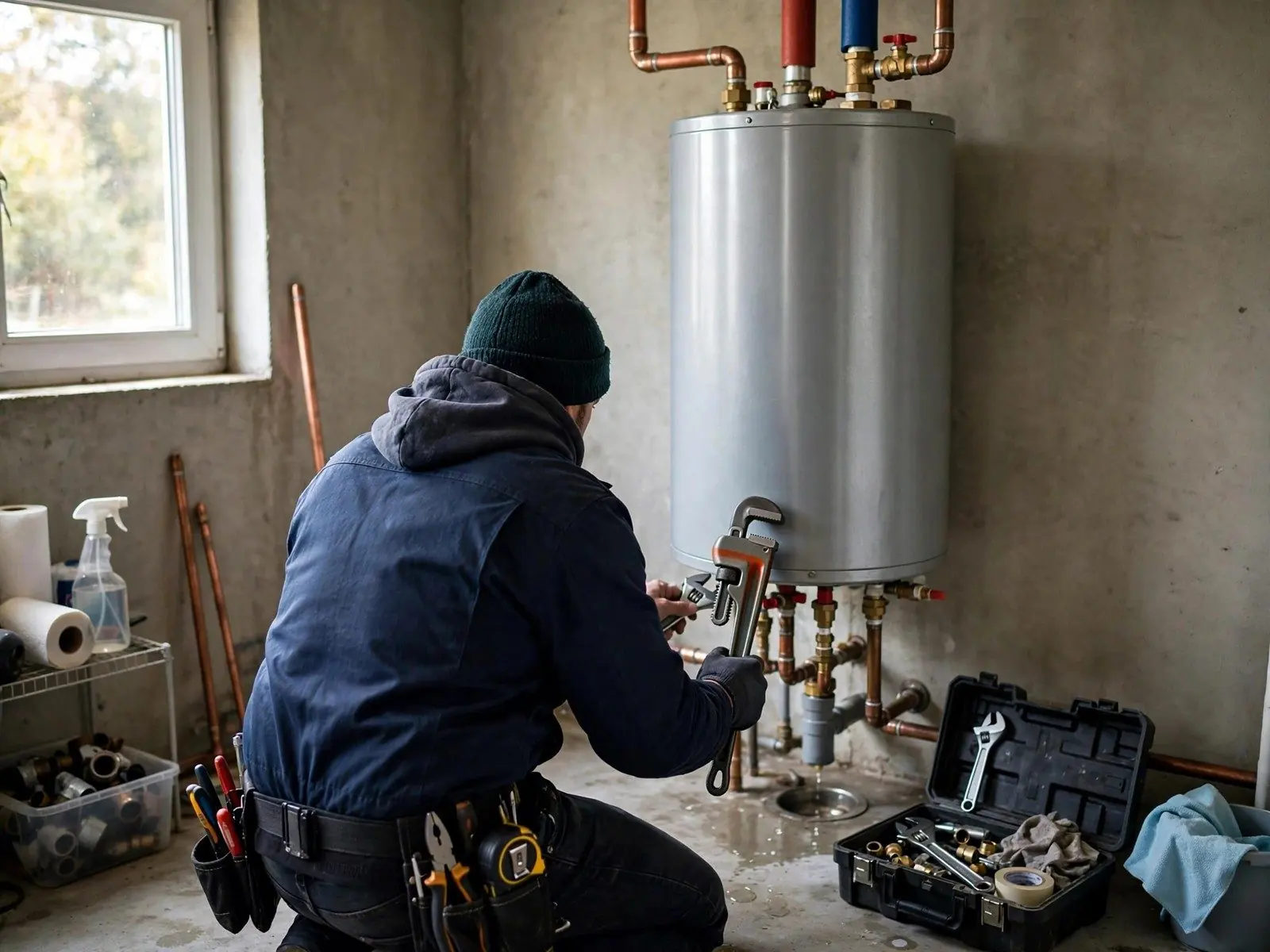
If water is spreading from the tank, close the cold supply valve above the heater and switch off the gas control or the breaker. Then call us, and the dispatcher will tell you what else to do while a plumber heads your way. Same-day appointments are available when the problem is a lukewarm shower instead of a flood, and nights, weekends and holidays are covered for active leaks.
Water pooling around the tank in the middle of the night
A wet floor under a water heater has several possible sources, and only one of them is fatal for the tank. Water can drip from the cold and hot connections on top, from the drain valve near the bottom, from the temperature and pressure relief valve, or from the tank body itself. Dry the area with a towel and watch where the first bead forms.
Beads at a threaded connection or at the drain valve are usually repairable. A loose fitting, a worn washer or a dripping drain valve can be fixed in one visit, often with parts the plumber carries. Moisture that seems to come from the jacket or from underneath the unit is different. That means the steel tank has corroded through, and no repair will hold.
Do not wait to see whether it stops. A slow tank leak can dump dozens of gallons before morning, and a finished basement soaks it up quickly. Shut off the cold supply, open a hot tap upstairs so the tank does not siphon, and move anything stored near the heater. We will tell you honestly if the unit is past saving, and replacement is then the sensible next step.
Shutting the heater down safely, gas or electric
Close the cold valve
Turn the handle on the cold pipe above the tank clockwise until it stops.
Kill the heat source
Set a gas control to off, or switch off the dedicated breaker for an electric unit.
Open a hot tap
Run one hot faucet upstairs so the tank can vent pressure and stop siphoning.
Contain the water
Move stored items, lay towels and use a wet vacuum if the pan is overflowing.
Where the hot water went
Most no-hot-water calls follow a short list of causes. The type of heater changes which cause is likely, so tell the dispatcher what fuel yours uses.
| Symptom | Likely cause | Heater type |
|---|---|---|
| No hot water at all, burner never lights | Pilot out, bad thermocouple or failed gas valve | Gas tank |
| No hot water, breaker keeps tripping | Shorted heating element | Electric tank |
| Water warm but never hot | One failed element or a thermostat set too low | Electric tank |
| Hot water runs out in minutes | Sediment on the tank floor or a broken dip tube | Gas or electric tank |
| Water turns cold mid-shower | Minimum flow not met or scale in the heat exchanger | Tankless |
| Rumbling or popping noises | Sediment layer boiling beneath the burner or element | Any tank |
| Water leaking from a pipe near the top | T&P valve discharge or a loose fitting | Any tank |
No hot water: the quick checks before you call
Cold showers rarely mean the whole heater has failed. On a gas unit, look through the viewing window for a pilot flame and check that the gas control knob is on the pilot or on setting. On an electric unit, reset the breaker once and test the reset button on the upper thermostat. If the breaker trips again, stop. A repeat trip means a shorted element or wiring fault, and repeated resets are a fire risk.
What a gas heater needs: pilot, thermocouple and burner
A standing pilot flame heats a small sensor called a thermocouple. If the flame goes out or the sensor weakens, the gas valve closes by design. Relighting the pilot is simple, but a pilot that keeps dying points to a worn thermocouple, a draft problem or a dirty burner tube. We replace the part, clean the burner and check the vent draft before leaving.
Gas smell: leave first, then call
If you smell gas near the heater, do not touch light switches or try to relight anything. Leave the building, then call Enbridge Gas (formerly Dominion Energy Utah) at 1-800-767-1689, or call 911 from a safe distance. Call us after the utility has cleared the house. A plumber should not work around a live gas smell, and neither should you.
Tank leaking or shower stone cold?
Call the 24/7 line and tell the dispatcher whether the heater runs on gas or electricity. We will talk you through the shut-off while a plumber is on the way.
Electric, gas and hybrid: how repairs differ
An electric tank uses two heating elements and two thermostats. Repair means testing each element with a meter, replacing the failed one and draining the tank partway first, which takes longer than a gas fix. Electric units seldom fail from the same causes as gas units, so a good diagnosis saves a lot of guesswork.
A gas tank has a burner, a gas control valve, a thermocouple or igniter, and a flue that must draw properly. Repairs are mostly part swaps, but every one ends with a check for gas leaks and flue spillage.
A hybrid (heat pump) water heater adds a compressor, a fan and an air filter on top of the electric elements. Many service calls on these are filter or condensate drain problems that a homeowner can spot. Compressor and sealed-system faults are warranty territory, so we tell you when the manufacturer should handle it. Our tankless water heater page covers on-demand units, which have their own error codes and scale problems.
Pressure relief valve discharge and what it means
The T&P valve is the safety device that opens if the tank gets too hot or pressure climbs too high. Most are rated to open around 150 psi or 210 degrees F. If a pipe attached to it is dripping, one cause is thermal expansion in a closed system, and another is a valve worn by mineral buildup. Never cap this valve. A tank with a plugged relief valve can rupture.
Water heater leak repair or replacement
Plumbers cannot patch a rusted-through tank, and anyone who offers to is selling a temporary fix. If the leak is at a fitting, we repair it. If the tank body is leaking, we say so plainly.
The price of an emergency call is better spent on a new tank than on a repair that fails again in a week. When the unit is also more than about ten years old, the case for a new one grows stronger, and our installation team can set the same-day replacement.
Earthquake strapping after a repair
Utah’s amendment to the plumbing code requires water heaters to be anchored or strapped against horizontal movement in an earthquake, with straps in the upper one-third and lower one-third of the tank. The city’s own design criteria place North Salt Lake in a high seismic category that depends on distance from the Wasatch Fault trace. In practice, if we pull a heater out to fix a vent or fitting, we also check that the straps are present and tight.
What drives the price of a water heater repair
We give a clear price before work starts. These are the factors that move it:
- Which part failed. A thermocouple or thermostat costs far less than a gas control valve or heat exchanger.
- Fuel type and tank size, because larger and electric units take more time to drain and refill.
- How accessible the heater is. Attic and closet installations take longer than a basement corner.
- Whether code corrections are needed, such as a missing drain pan, loose straps or a bad vent connection.
- Time of day. After-hours dispatch is quoted separately from a scheduled visit, and we tell you the number before anyone is sent.
Homeowners insurance typically covers sudden and accidental water damage, not a heater that wore out. If a leak soaked flooring or drywall, ask your insurer what applies.
What the plumbing code expects
Repairs that touch the relief valve, gas line, venting or water piping fall under the 2024 International Plumbing Code (IPC), which Utah adopts from July 1, 2026. A like-for-like part swap rarely changes that, but anything that alters the installation is checked against it.
Frequently asked questions
Yes. The line is answered 24/7, including holidays. If water is leaking or the gas smells, say so right away so the dispatcher can send the right plumber and give you shut-off instructions.
Close the cold water valve on the pipe above the tank by turning the handle clockwise. Then turn the gas control to off, or flip the heater breaker. Open a hot faucet somewhere in the house so the tank can relieve pressure.
Sometimes. A leak at a fitting, the drain valve or the T&P valve can usually be repaired. A leak through the tank wall cannot, and replacement is the only fix.
Common causes are a worn thermocouple, a blocked burner tube or a draft pulling the flame off. We test the thermocouple first because it is a quick and inexpensive part.
Tanks often carry a warranty on the tank itself, with shorter coverage on parts. Keep the model plate details handy, and we will tell you what a warranty claim would require.
A like-for-like part swap generally does not. Replacing the heater or changing gas, vent or water piping typically does. Permits go through the city Building Department at 10 E Center Street, and Utah limits what homeowners may do themselves, so check with the Building Department and DOPL.
Yes. The same dispatch line reaches Woods Cross, which borders North Salt Lake, and we can send the same plumber and the same tools.