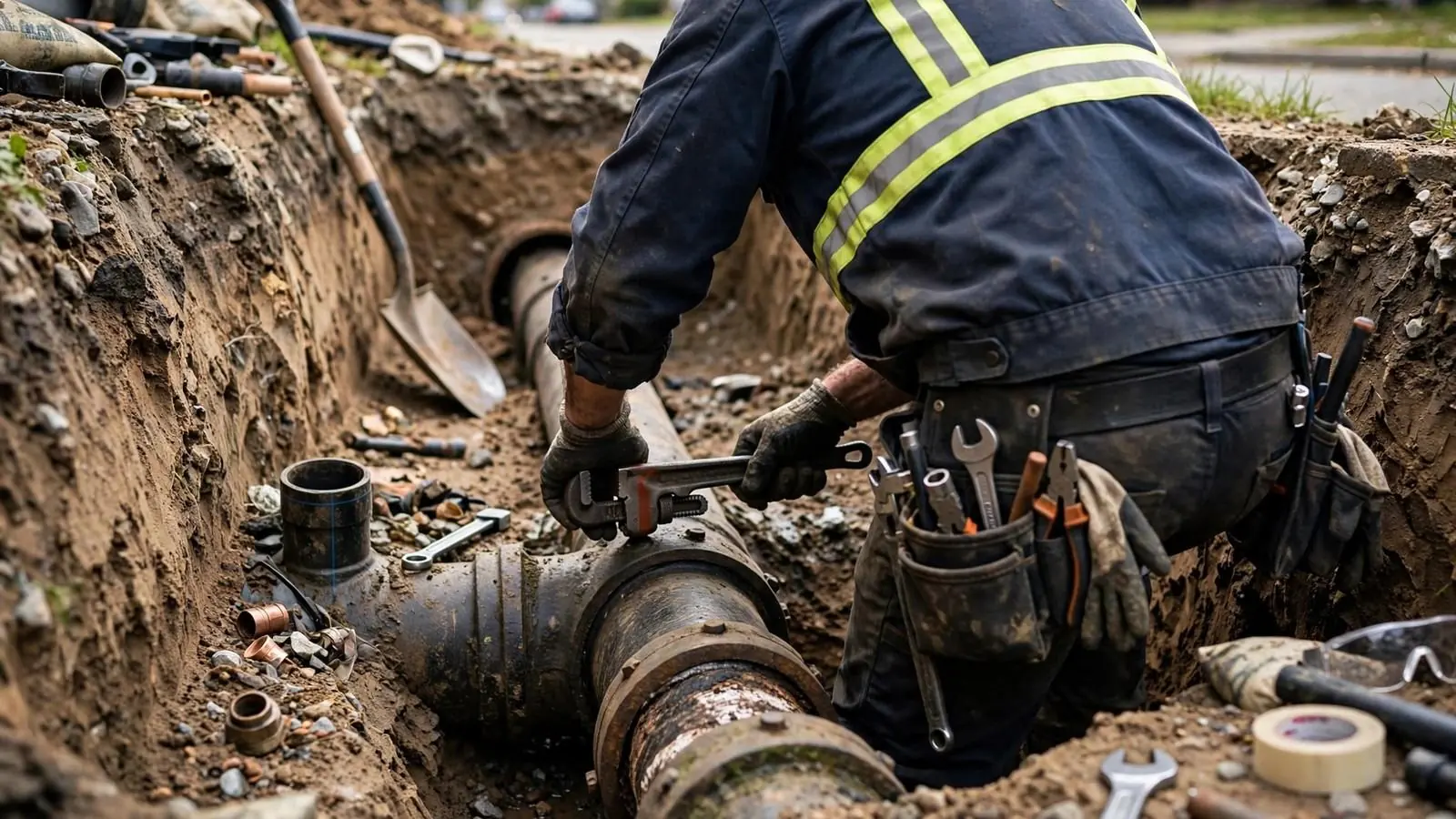
If sewage is coming up in a tub, shower or floor drain, stop using water in the house and keep everyone out of the wet area. A damaged line can leak into the soil for months before it backs up, so the backup is often the first obvious sign. Same-day appointments are available for slower problems, and nights, weekends and holidays are covered when a line has failed.
Emergency sewage backup that cleaning cannot fix
There are two kinds of backup. One comes from a blockage that cleaning removes. The other comes from a pipe that is broken, so the blockage grows back. If a line backed up, was cleared, and then backed up again within weeks, the second kind is likely.
We clear the line first, because a flooded basement cannot wait for a repair plan. Then a camera goes in. The footage shows whether the problem is a rooted joint, a sag where water collects, an offset where two pipe sections no longer line up, a crack, or a full collapse. Each has a different repair, and the camera lets us explain which one you have instead of guessing.
How a failing sewer line shows itself
| Sign | Likely cause | What it usually leads to |
|---|---|---|
| Backups that return within weeks of cleaning | Roots in a joint or a sag in the pipe | Camera inspection, then spot repair or lining |
| Gurgling toilets and slow drains in several rooms | Partial blockage in the main | Cleaning, then a camera to check the wall |
| A sewer smell in the yard or basement with no backup | A leak from a crack or open joint | Camera and likely repair |
| A sunken or unusually green patch above the line | Soil washing into a break or sewage feeding the lawn | Camera and often excavation |
| Water in a basement floor drain after heavy use | A main line near its limit | Cleaning, then inspection for damage |
What the pipe is made of, and how it fails
Sewer laterals are not all the same. The material usually tells you the likely failure.
Clay. Common in older homes. It resists corrosion but comes in short sections, so there are many joints for roots to enter. Clay also cracks if the ground shifts.
Orangeburg. A pipe of layered tar paper and pitch used in some mid-century homes. It softens, flattens at the bottom and can collapse into an oval.
Cast iron. Strong, but it rusts from the inside, creating scale that narrows the pipe and eventually cracks or perforates the bottom.
PVC and ABS. Smooth and light, with few joints. It rarely fails by itself. Problems usually come from a poor joint, a sag from bad bedding or damage during other digging.
The 2013 General Plan puts North Salt Lake’s first wave of homes between about 1910 and 1960 west of Orchard Drive and east of Main Street. For a home in that area, a camera inspection is the sensible first step when a line has repeated problems, because the original lateral may be clay, cast iron or Orangeburg.
Foxboro homes, built from 2000 to 2010, almost always have plastic laterals, and a repair there is more often a joint or sag than age.
Roots: why they come back and what ends it
Roots do not break a healthy pipe. They find an open joint or crack, enter as hair-thin threads and thicken into a mat that traps paper and grease. A cable can cut the mat, and hydro jetting can clear more of it, but the roots return because the opening is still there.
The permanent fix is to seal that opening. That means replacing the failed section, or lining the pipe so there is no gap for roots to find. Chemical root killers sold for flushing are not a repair, and they do not close a joint.
Trenchless repair and open trench, compared honestly
There are four main ways to fix a sewer line. None is best everywhere, and cost depends on length, depth, access and what is above the pipe.
| Method | What it is | Good for | Trade-offs |
|---|---|---|---|
| Spot repair | Cut out and replace a short damaged section, usually by digging a small pit | One broken joint or a short crack | Needs an excavation at that spot, and the rest of an old pipe stays as is |
| CIPP lining | A resin-soaked liner is pulled in and cured, forming a new pipe inside the old one | Cracks, root entry and joint leaks along a stretch of pipe | Cannot fix a bad sag or collapsed section, and it slightly reduces pipe diameter |
| Pipe bursting | A cone pulls new pipe through while breaking the old one outward | Replacing a full run of failing pipe with little digging | Needs entry and exit pits and can disturb nearby utilities |
| Open trench | Dig up and replace the line | Collapsed, badly bellied or misaligned pipe, and short runs | Most disruption to landscaping, driveways and sometimes structures |
The cheaper-looking option is not always the cheaper one in the end. A liner over a sagging pipe still holds water at the sag. A trench through a short, shallow run may cost less than a bursting setup. The camera footage and the length of the run decide the answer, and we will show you why.
Sewer line failing under your yard?
Call the 24/7 line. We will stop the backup first, then show you on camera what is wrong and what the repair choices are.
How a repair visit goes
Stop the backup
We clear the line or isolate it so the house is usable and the water is gone.
Camera and locate
We record the footage and mark the depth and position of the damage above ground.
Explain the options
You see the footage, hear which methods can work and get a clear price for each.
Repair and test
After the work we run the camera again and check flow, and we handle the permit.
What drives the cost of a sewer line repair
We give you a clear price before work starts. The usual factors are:
- The length of pipe that must be repaired or replaced.
- The depth of the line and what lies above it, such as driveway, patio, trees or utilities.
- The method, since lining, bursting and trenching are priced differently.
- Whether access pits or a new cleanout need to be added.
- Permit, inspection and any district fees.
Homeowners insurance generally pays for sudden and accidental damage, not for wear, roots or aging pipe. Coverage for the backup and for the pipe repair is often treated differently, so ask your insurer before you decide.
Permits, the district and local rules
Replacing or relocating sewer pipe needs a plumbing permit. In North Salt Lake that goes through the Building Department at 10 E Center Street, with permits applied for through the City Inspect portal. Plumbing permits generally have no plan review, and the over-the-counter permit fee is $50.50. Inspections run Monday to Thursday.
Sewer service is provided by the South Davis Sewer District, 801-295-3469. The district requires impact fees before a new lateral or added fixtures, and its inspector inspects the work with about four hours of notice. The city building permit does not include the district’s fee. If your property is in a sensitive-lands area, usually east of Highway 89, a Geo Hazard Review may also apply. Confirm all of this with the Building Department before you dig, since fees change.
Choosing the right repair for your home
If the lateral is plastic and the damage is one joint, a spot repair is usually enough. If an old clay line has roots at several joints over a long run, lining or bursting can avoid a long trench. If the line is collapsed or has a big sag, the pipe will likely need to be dug and replaced.
When you are still deciding, a sewer camera inspection on its own gives you the footage to compare bids. Once a line is repaired, sewer line cleaning keeps maintenance simple. Our reach includes neighbors just north of the city, and our Woods Cross page explains the coverage.
Code that governs a sewer repair
Sewer repairs must meet the plumbing code Utah enforces, the 2024 International Plumbing Code (IPC) from July 1, 2026, which sets slope, pipe material and cleanout rules. The South Davis Sewer District adds its own inspection and fee requirements, so a plumber should confirm both before the trench is opened.
Frequently asked questions
Yes. The line is answered 24/7. If sewage is backing up at night, a plumber can clear the line to stop the flooding, run a camera and lay out repair options, with any digging scheduled for daytime unless the line is collapsed.
Repeat backups, a sunken patch in the yard or a sewer smell outside point to a break. A camera settles the question in one visit.
No. Trenchless methods avoid most of the digging, but a collapsed or badly sagging pipe often cannot be lined or burst. We will tell you when a trench is the honest answer.
It varies with method and length. A spot repair can be done in a day, while a long replacement may take longer. We give you a schedule once the camera work is complete.
Yes, replacing or relocating sewer pipe needs a plumbing permit from the Building Department, and new laterals involve district impact fees. We handle the permit on work that requires one.
Usually not for age or root damage, although sudden damage may be treated differently. Ask your insurer before work begins.
We cannot tell from the city’s published information where the district’s responsibility ends. Call the South Davis Sewer District to ask, and bring our camera footage if the problem is near the connection.