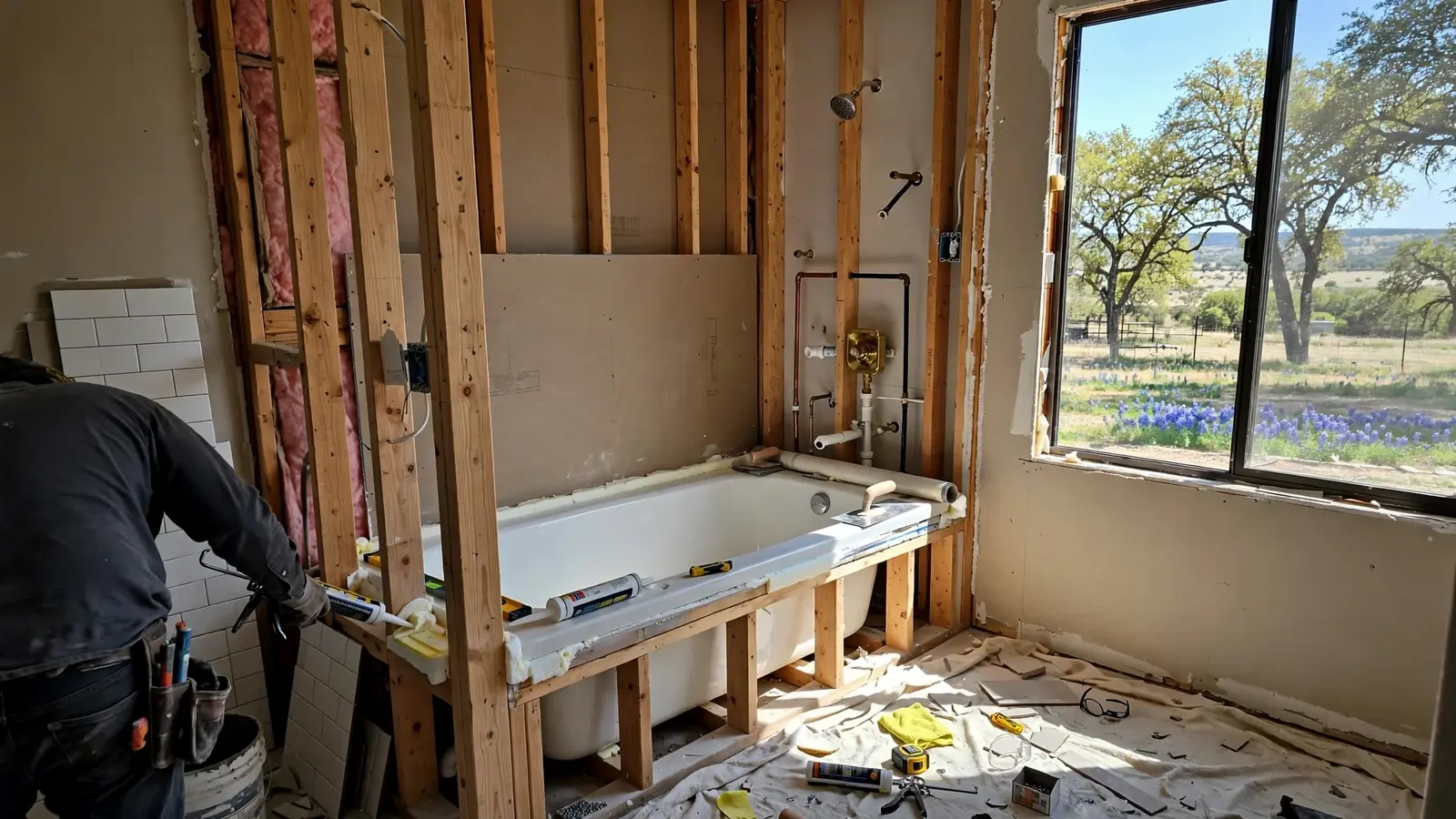
Knowing the parts turns "my tub is leaking" into a short list of suspects. A drip under the tub points to the drain side. Water behind the wall at the faucet end points to the supply side. A tub that fills slowly or sends water to the wrong outlet points to the valve or diverter.
The drain side, from the tub down
Water leaves through the drain flange, the visible ring in the tub floor. It screws into the tub shoe, a short fitting under the tub with a rubber gasket between it and the tub bottom. Plumber’s putty under the flange rim seals the top.
The stopper sits in the flange. Push-pull and toe-touch stoppers screw onto a threaded post. Lift-and-turn stoppers use a set screw. Trip-lever models hide a linkage rod and a plunger inside the overflow pipe, which is why the lever on the front of the tub controls the plug.
Next is the overflow. A faceplate on the tub wall opens into a vertical riser that stops a tub from spilling over the rim. The riser and the drain arm from the shoe meet at a sanitary tee. From the tee, a tailpiece drops to the P-trap, the U-shaped bend that holds a water seal and keeps sewer gas out of the bathroom.
The supply side, from the wall out
Hot and cold lines reach the tub through stop valves (when the house has them), then a mixing valve inside the wall. The valve blends hot and cold water and is the part you control with the handle. Modern valves use a replaceable cartridge, so a drip at the spout often means a worn cartridge rather than a bad valve body.
The spout delivers water to the tub. If your tub has a shower, a diverter sends water up to the showerhead. Some diverters are a pull-up knob on the spout. Others are a separate handle or a built-in section of the mixing valve. When the shower stream is weak and the spout keeps running, the diverter is the usual cause.
Parts, failures and where you see the water
This table matches what you notice to the part most likely behind it.
| Part | What it does | Common failure | What you notice |
|---|---|---|---|
| Drain flange and shoe gasket | Seals the tub bottom to the drain | Dried putty or hardened gasket | Drip under the tub only when it is full or in use |
| Overflow gasket | Seals the riser to the tub wall | Cracked or compressed rubber | Wet ceiling below after a bath, dry during a shower |
| Stopper and linkage | Holds water in the tub | Hair, rust, stretched linkage | Tub slowly empties or will not hold water |
| Tailpiece and trap | Connects the tub to the branch drain | Loose slip nuts, corroded metal | Drip or damp patch at the access panel |
| Mixing valve cartridge | Blends hot and cold | Worn seals or mineral buildup | Drip from spout, handle hard to turn |
| Diverter | Switches spout to shower | Worn seal or stuck gate | Water at the spout while showering |
| Supply stops and lines | Bring water to the valve | Corroded fittings, loose nuts | Damp wall at the access side, hissing |
Common leaks and what causes them
Most tub leaks come from the drain side, because the seals sit under constant load and see soap and heat. A leak that appears only during a bath, not a shower, suggests the overflow gasket, since a full tub is the only time that gasket is submerged. A leak that appears during a shower suggests the drain flange or shoe gasket.
Supply-side leaks tend to be steady. If a wall is wet whether or not anyone has used the tub, a pressurized line is the suspect. A leak detection visit can find the source before anyone opens the wall, and our leak detection page explains the tools.
Signs it is time to call
- A ceiling stain below the bathroom that grows after baths.
- A soft or spongy floor near the tub edge.
- A drain that gurgles when other fixtures run, which can point beyond the tub trap. A drain cleaning visit tests the branch line.
- Water at the spout while the shower is on, after you have pulled the diverter fully.
- Persistent musty smell from the tub access panel.
Water showing up below the tub?
Call the 24/7 line. Describe the ceiling or wall stain and we will tell you whether to shut off the water while a plumber heads your way.
What a licensed plumber replaces and what a homeowner can reach
Cleaning a stopper, swapping a pop-up stopper and re-sealing the flange with fresh putty are the reachable jobs. Replacing the whole waste and overflow kit, a cartridge in a wall valve or the trap involves more risk. If the tub has no access panel, the repair may mean opening the wall from an adjacent room or cutting a neat panel in drywall.
Utah limits what homeowners may do themselves. Repairing an existing fixture is treated differently from modifying piping or installing a fixture for the first time, so check with the Building Department and DOPL before you start. Moving a tub drain or changing a valve location falls on the plumber’s side of that line, and it is the kind of work our plumbing installation crews do with a permit.
Older drain lines behind the tub
The 2013 General Plan describes a first wave of North Salt Lake homes built from about 1910 to 1960 west of Orchard Drive and east of Main Street. Tub drains from that era may be galvanized steel or cast iron, and these metals corrode from the inside. A tub in one of those homes that drains slowly after a good cleaning may have a narrowed pipe, and replacing the section under the tub is cheaper than repeated cleaning.
Foxboro, built from 2000 to 2010, was framed with plastic drain parts, which do not rust. Tub problems there are usually a gasket, a hair clog or a loose slip nut.
North Salt Lake notes for tub work
Plumbing permits in North Salt Lake are issued by the Building Department at 10 E Center Street through the City Inspect portal. The quick-facts sheet lists plumbing permits as generally needing no plan review, with an over-the-counter fee of $50.50.
If you add a fixture or a new drain, the South Davis Sewer District (801-295-3469) may require impact fees before work starts, and the city permit does not cover them. Ask before moving a tub or adding a second one.
Utah’s plumbing code is the 2024 International Plumbing Code (IPC) from July 1, 2026. It requires a trap and vent on every fixture drain, which is why a tub relocation is more than a pipe swap. The city’s winter design temperature is 8 F, so a tub on an exterior wall needs insulated supply lines that a warm interior wall does not.
Neighboring towns we dispatch to
The same 24/7 line serves Woods Cross and Bountiful, both of which border North Salt Lake. Homes built in the 1950s through the 1970s in those towns often have the same older tub drains described above, so the diagnosis steps are the same.
Frequently asked questions
It sits directly under the tub, between the tailpiece and the branch drain. In a ground-floor home with a crawl space or basement, you reach it from below. In an upstairs bathroom, it is often behind an access panel on the wall at the drain end of the tub.
The tub has its own trap and a smaller path through the shoe and tee. Hair and soap collect at the stopper and trap first. If cleaning the stopper does not help, the clog is in the trap or branch line.
Yes. The overflow riser joins the drain at the sanitary tee, below the tub. That means the overflow gasket can leak into the wall or ceiling even when the drain flange is perfectly sealed.
It is the part that sends water to the spout or up to the showerhead. When it wears out, some water keeps coming out of the spout during a shower.
Utah treats repair of an existing fixture differently from changing piping. Swapping a like-for-like cartridge is a repair on an existing fixture. Check with the Building Department and DOPL if the work involves cutting or moving pipe.
The city’s 2024 water quality report shows total dissolved solids of 888 to 980 mg/L, a high mineral content. Minerals can collect inside cartridges and diverters, so stiff handles are worth attention sooner.