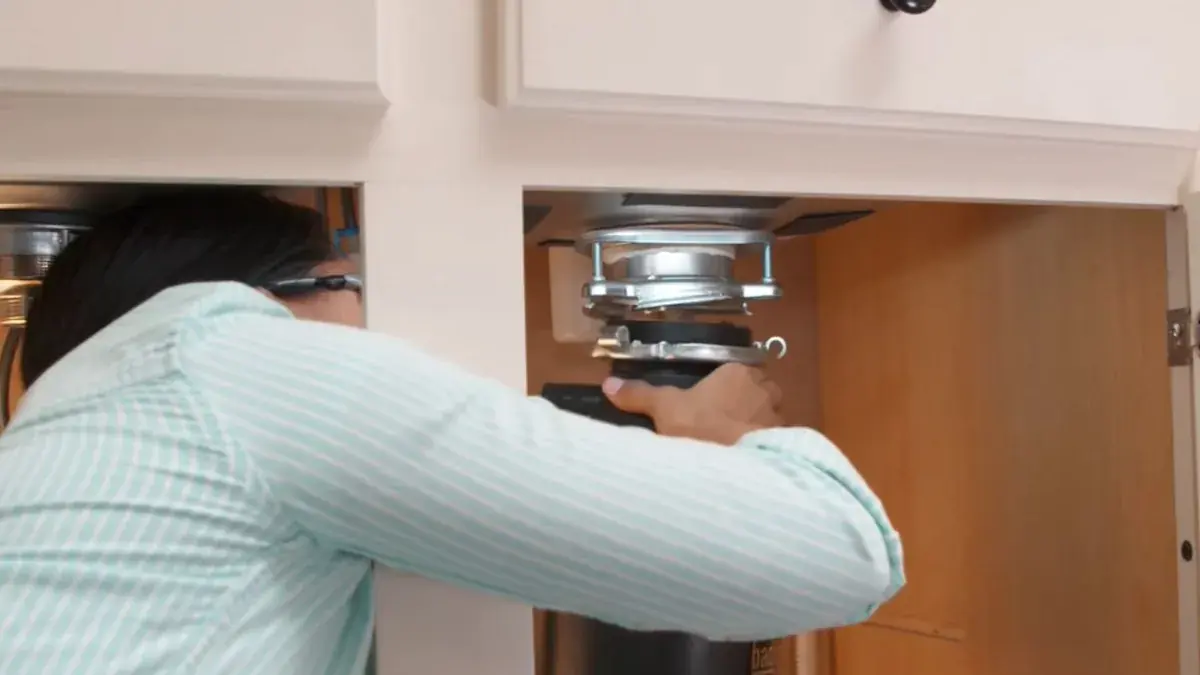
Glacier Bay is a retail brand of disposals, and we have no affiliation with it. Models differ in horsepower, mounting hardware and wiring, so this guide covers general steps and leaves out model details. Your instruction sheet wins wherever it disagrees with this page.
What you need before you begin
A disposal installs under a kitchen sink, so clear the cabinet and put down a towel and a bucket. Turn off power to the circuit at the breaker, not only at the wall switch. Gather plumber’s putty, a screwdriver, pliers or a slip-joint wrench, a hammer and a wooden dowel or steel punch for the dishwasher knockout.
Check three things first. The sink’s drain opening must be a standard size, which most kitchen sinks have. There needs to be space below for the disposal and its discharge elbow. And you need a switched outlet or a switched, permanently wired connection.
Install steps, in order
Remove the old unit or strainer
Disconnect the trap and old disposal, clean the sink opening and scrape off old putty.
Set the sink flange
Press a rope of plumber’s putty under the flange, seat it from above and tighten the mount from below.
Hang the disposal
Attach the mounting ring and gasket, lift the unit into place and twist it until the mount tabs lock.
Connect, wire and test
Attach the discharge elbow and trap, connect the dishwasher hose and power, then run water and check for leaks.
The dishwasher knockout
Most disposals have a dishwasher inlet with a plastic plug inside it, called the knockout. If a dishwasher connects to the disposal, the plug must come out before the unit is hung. Use a hammer and a wooden dowel or a steel punch, and do not use a screwdriver.
Forgetting this step is the classic mistake. The dishwasher then cannot drain, and standing water in the dishwasher is the symptom. If the plug falls into the chamber, take it out by hand with the power off, or let the grinder clear it.
The dishwasher hose connects to the inlet with a clamp. Whether the hose needs an air gap or a high loop is a local code question, so confirm it with the Building Department. The drain hose should rise to the underside of the counter before it drops to the disposal.
Electrical: plug-in or hardwired
Many disposals ship without a cord, and others have one. A plug-in model connects to a grounded outlet under the sink, controlled by a wall switch. A hardwired model connects to a cable through a wiring compartment on the bottom of the unit, with the ground connected correctly.
Wiring is where DIY goes wrong. Never ground to a gas pipe. Wire colors and connections are set by your unit’s sheet, so follow it exactly. If you have no switched outlet under the sink, adding one is electrical work and may need an electrician and a permit. Our garbage disposal repair page covers units that already exist and are failing.
Matching the unit to the sink
Disposal choices come down to a few features.
| Feature | Lower end | Higher end | What it changes |
|---|---|---|---|
| Horsepower | Smaller motors | Larger motors | Grinding speed and how well it handles dense scraps |
| Mounting | Basic three-bolt mount | Quick-lock mounts | How easy the unit is to remove later |
| Noise insulation | Little | Added insulation | Sound level under the sink |
| Feed type | Continuous feed | Batch feed | Whether it runs with the stopper off or on |
| Cord | No cord | Cord included | Whether wiring is hardwired or plug-in |
Disposal leaking under the sink?
Call the 24/7 line. Switch the unit off at the wall and keep the cabinet dry until a plumber arrives.
What a disposal should not grind
- Bones, fruit pits and shells.
- Grease and cooking oil, which cool and coat the drain.
- Stringy food such as celery, corn husks and onion skins in quantity.
- Large amounts of coffee grounds, which settle in the trap.
- Glass, metal, plastic and chemicals.
- Anything while your hand is in the sink. Switch off power first and use tongs.
When to call a plumber instead of installing
A like-for-like replacement of a working disposal under the same sink is a reasonable weekend job for many people. Other jobs are not. If the sink strainer needs replacing, the drain is cracked, the trap arm does not line up or the cabinet has no outlet, call a plumber.
Utah limits what homeowners may do themselves. Repairing an existing fixture is one thing, but modifying piping or installing a fixture for the first time is another. A first-time disposal install can fall on the licensed side of that line, so check with the Building Department and DOPL. If you also want a new sink or a changed drain, our plumbing installation page describes how that scope is handled.
North Salt Lake notes for disposals
Plumbing permits come from the Building Department at 10 E Center Street through the City Inspect portal. The city’s quick-facts sheet lists plumbing permits as generally needing no plan review, at $50.50 over the counter, with inspections Monday to Thursday.
Sewer service is from the South Davis Sewer District (801-295-3469), and added fixtures can carry impact fees that the city permit does not cover. A disposal does not make food solids disappear, which is why grease and fibrous scraps still cause kitchen line clogs.
Homes from about 1910 to 1960 west of Orchard Drive may have cast iron or galvanized kitchen drains that roughen inside, and a disposal’s ground food collects there more easily. Foxboro homes from 2000 to 2010 mostly have smooth plastic.
Nearby towns
We dispatch from North Salt Lake to Bountiful and Woods Cross on the same 24/7 line, and the same installation steps apply there.
Frequently asked questions
Yes, if a dishwasher will drain through the disposal. Use a hammer and dowel or a punch before hanging the unit. Leaving the plug in blocks the dishwasher.
Not without electrical work. The unit needs a switched outlet or a hardwired connection. Adding one may need a licensed electrician.
Brands and models differ in mounting hardware and cords. Use the parts and instructions that came with your unit, and do not mix hardware between models.
Utah’s homeowner exemption is narrow and covers minor repair of an existing fixture, not first-time installation or changes to existing piping. Ask the Building Department and DOPL, or call a licensed plumber.
The trap or the line below it is partly blocked, or the dishwasher connection is clogged. A camera and cable run find the cause.
It adds food solids to the line. In older cast iron kitchen drains, those solids settle more readily, so scrape plates and keep grease out.