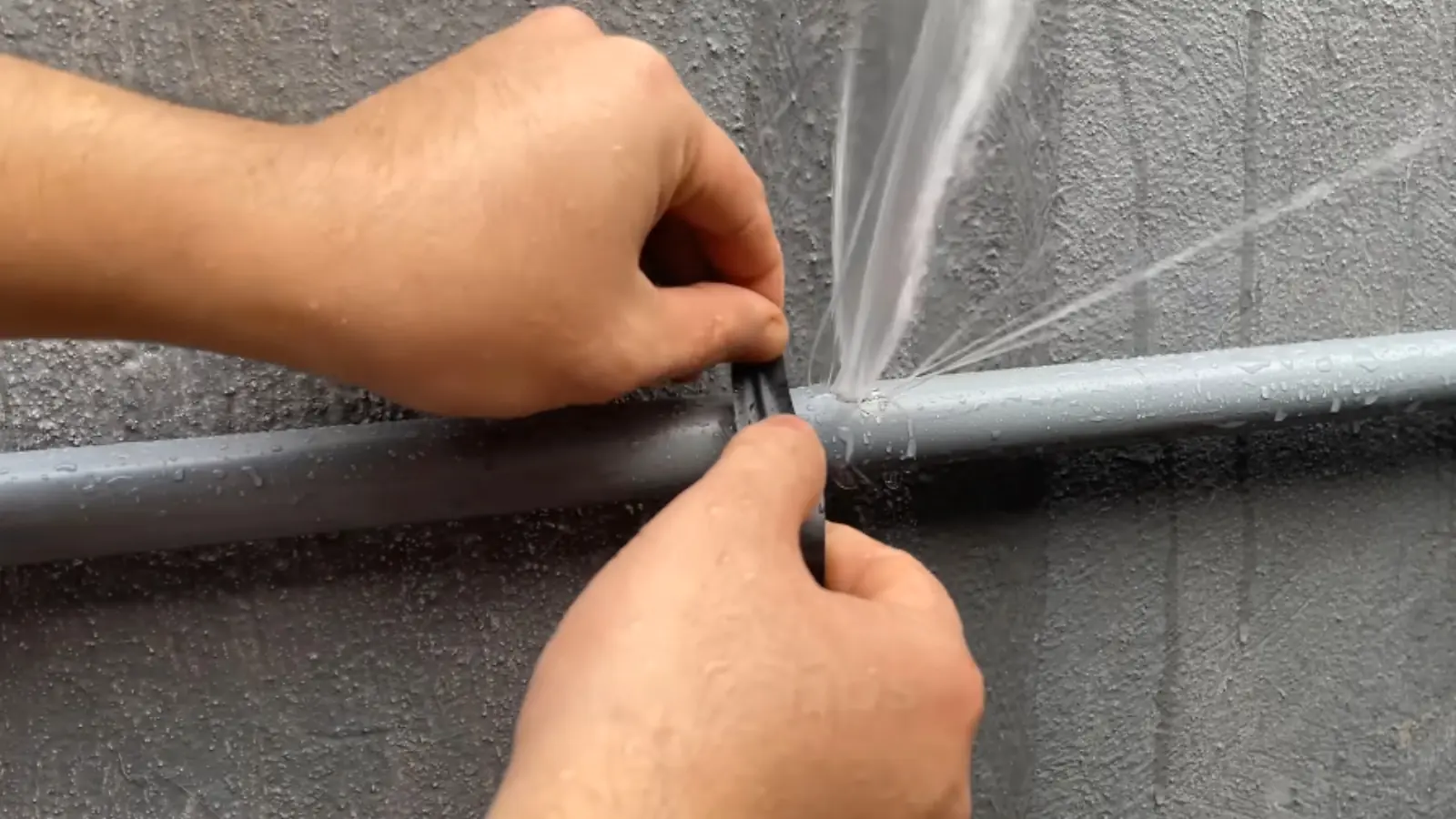
First stop the water at the nearest valve, then dry the pipe and mark the wet spot. If you cannot find a valve that works, close the main water valve.
Find out which pipe you have
PVC shows up in three places in a house, and each one fails differently.
White or cream PVC is used for drains and vents, and for cold supply lines in some homes. Black pipe under a house or in a wall is often ABS, a similar plastic drain material that uses different cement, so do not mix the two. Gray or white pipe in the yard may be an irrigation line, which holds low pressure and is thinner than household supply.
One rule matters most: standard PVC is not rated for hot water. If a pipe feeding a water heater or a tap that runs hot has a leak, the pipe may be CPVC, copper or PEX, and the repair kit is different. Check the printing on the pipe or ask a plumber.
Match the leak to the repair
Use this table to pick a fix that fits the damage. Temporary patches are for buying time, not for leaving in a wall.
| Leak | Typical cause | Temporary fix | Lasting fix |
|---|---|---|---|
| Weeping glued joint | Poor cement bond or movement | Epoxy putty or tape | Cut out and replace with a coupling |
| Crack along the pipe | Impact, freezing or stress | Repair clamp | Replace the section |
| Hole from a screw or nail | Drilling or fastening | Rubber and clamp | Slip coupling on cut section |
| Leaking threaded fitting | Overtightened or old tape | Reseat with new tape | Replace the fitting |
| Cracked fitting after a freeze | Ice expansion | Shutoff and drain | Replace the fitting and check the line |
| Leaking drain at a joint | Poor slope or shifted pipe | Resealing | Re-cement the joint, then re-hang the pipe |
Why PVC joints leak
Most PVC leaks come from joints, not from the pipe wall. A solvent-welded joint depends on clean cut ends, primer where the code or product calls for it, the right cement and a firm push-and-hold. If any of that was skipped, the joint can fail months or years later.
Movement also matters. Pipes that expand with temperature, or that sag between hangers, put stress on joints. Impact from a stored box or a lawn tool cracks a pipe wall that was already brittle from age and sun.
Cold is the other enemy. Water that freezes inside a pipe expands and splits it. The city’s design criteria use a 30-inch footing frost depth and an 8 F winter design temperature, so outdoor lines that are not buried below frost, or that sit in unheated spaces, are at risk each winter.
The permanent repair, step by step
Shut off and drain
Close the valve, open a low faucet and let the line empty so cement bonds on dry pipe.
Cut out the damage
Cut square on both sides of the leak, with a clean edge, and deburr the ends.
Dry fit the new section
Test the coupling and new pipe length with no cement, and mark the alignment.
Cement and hold
Apply primer and cement, push, hold and let it cure per the label before pressurizing.
What to expect from do-it-yourself fixes
- Epoxy putty can stop a seep, but it fails if the pipe is wet or under high pressure.
- A repair clamp suits a small crack in a straight run and buys time.
- Slip couplings need room to slide, which is why they suit a cut-out repair.
- Cement cure times vary by brand and temperature. Read the label before turning the water back on.
- Do not use PVC cement on ABS or the reverse.
- If the leak is behind a wall or under a slab, stop and call a plumber.
PVC leak you cannot stop?
Call the 24/7 line. We will tell you which valve to close and send a licensed plumber to replace the damaged section.
What changes the price
A visible joint repair is a short job. Cost depends mostly on access: a pipe in the open is fast, while one inside a wall, ceiling or crawl space means opening finished surfaces. Pipe size, how many fittings are involved and whether the leak is on the supply or drain side all matter. Long leaks that have soaked insulation or drywall add drying and repair.
Homeowners insurance usually covers sudden and accidental water damage, not slow seepage from a joint that was failing for months. Ask your insurer, and document the damage with photos.
What North Salt Lake means for your repair
Utah limits what homeowners may do themselves, and modifying existing piping is not part of the homeowner exemption. Check with the Building Department at 10 E Center Street, which issues plumbing permits through City Inspect for $50.50 over the counter, usually with no plan review. You can verify a plumber’s license on the state’s DOPL lookup at secure.utah.gov/llv/search/index.html.
Utah’s current code is the 2024 International Plumbing Code (IPC), in force from July 1, 2026. For you, that means a repair that replaces pipe should follow current rules, and a plumber pulls the permit if one is needed. For a leak that will not stop, the city’s after-hours water emergency line is 801-560-3718.
Older homes and newer ones
The city’s General Plan puts the first wave of homes between about 1910 and 1960. Those homes were piped with other materials, so PVC there is usually a later repair that joins old galvanized or copper lines to plastic. Joints between mixed materials need the right transition fittings, not just cement.
Foxboro homes, built from 2000 to 2010, are more likely to have PVC or similar plastics in their drains and some supply lines. If a joint is leaking there, the cause is often workmanship or movement. Homes near West Bountiful and Centerville follow the same pattern.
When it is time to call
Call for any leak behind a finished wall, under a slab or on a supply line that will not shut off. Also call if the pipe is hot, if the same joint has been patched twice or if the damage covers a long run. Our water line repair page explains what we replace and how, and a burst pipe is handled as an emergency.
Frequently asked questions
For a small seep, epoxy putty or a clamp can slow it, but these are stopgaps. A permanent repair cuts out the damaged section and uses a coupling and PVC cement.
The label sets the time, and it depends on pipe size, temperature and humidity. Cold weather slows curing. When in doubt, wait longer than the minimum.
Standard PVC is not rated for hot water. Hot lines use copper, PEX or CPVC. If a hot line is leaking, identify the pipe before buying repair parts.
A joint may be loose, or the pipe may have shifted. A big surge of water puts pressure on weak joints. A plumber can re-cement the joint and secure the pipe.
Freezing can split PVC. City design criteria list an 8 F winter design temperature and a 30-inch frost depth, so exposed or shallow lines need protection.
Often yes, because replacing piping is more than a fixture repair. Call the Building Department at 10 E Center Street to confirm before you cut.