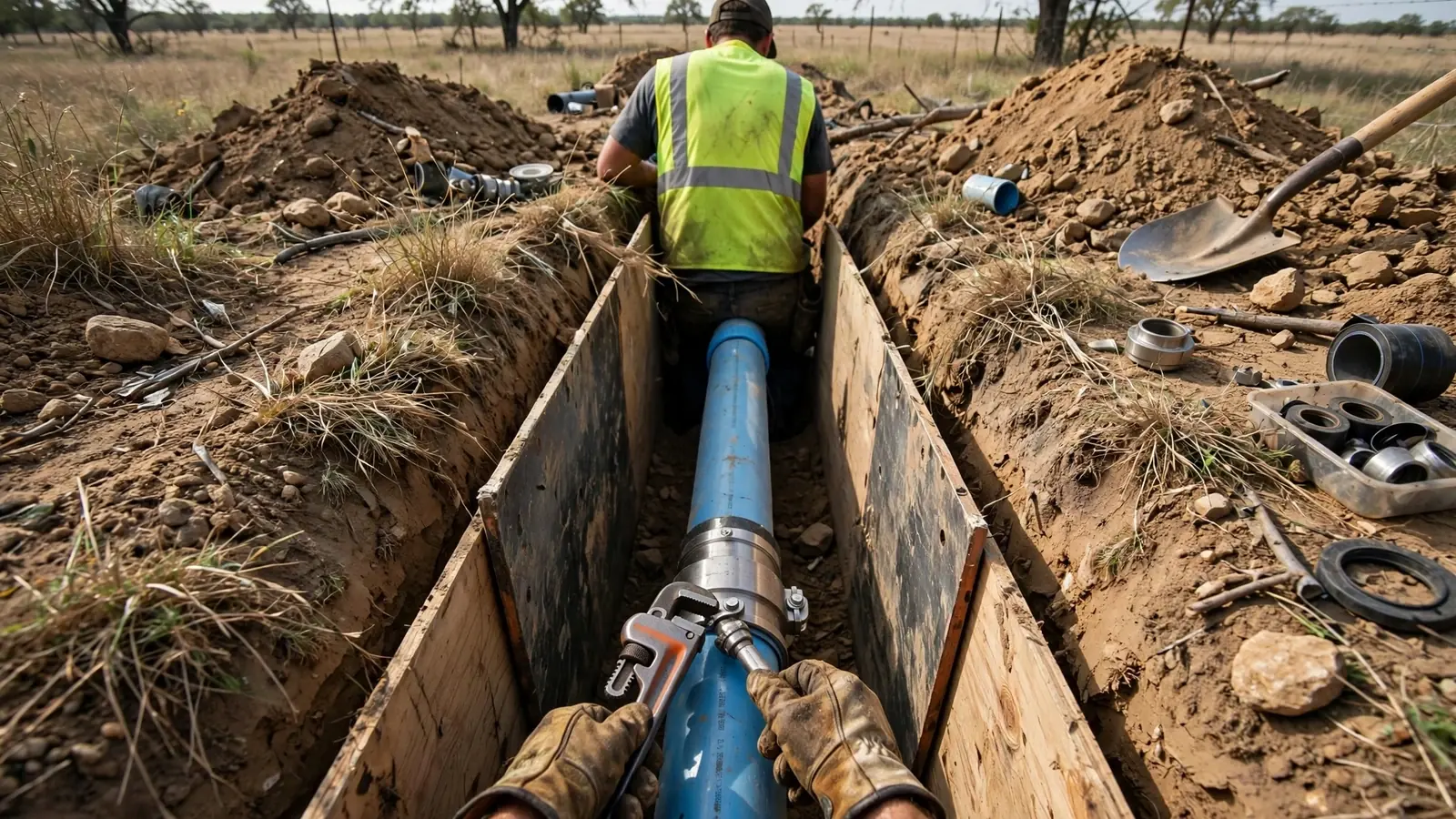
If water is surfacing in the yard or pouring into a basement, close the main valve at the house and call. Same-day appointments are available when the leak is small, and nights, weekends and holidays are covered for a line that is flooding. While you wait, keep people away from soft or sinking ground.
Emergency water service line leaks
The service line is the buried pipe that carries water from the street connection to your house. When it leaks, the signs are usually outdoors. Look for a spot of grass that is greener or soggier than the rest, a sunken patch in the driveway, or a faint hiss near the meter box. Inside, the whole house may lose pressure at once.
We trace the buried line with a pipe locator, listen along it, and run a pressure test to confirm the line is losing water. Then we explain the choices: repair a short section, or replace the whole run when the pipe is old, corroded or has failed more than once. Our leak detection page describes how those tests work.
The line between the meter and the house
Your service line has two sides. One is the stretch between the street and the meter, and the other is between the meter and the house. Where the city’s responsibility ends and yours begins is not spelled out in the city information we reviewed, so ask Public Works at 801-335-8726 (after hours 801-560-3718) before paying for work on a line near the meter.
A practical way to tell which side is leaking is the meter test. Close the main valve at the house and watch the meter. If it keeps moving, the leak is between the meter and your valve. If it stops, the leak is inside.
Low water pressure: causes and what to check
Low pressure at every tap points to the service line, the main valve or the pressure regulator. Low pressure at one fixture usually means a clogged aerator or cartridge, and one-fixture problems are covered on the faucet repair page.
Common whole-house causes include a partly closed main valve, a leak in the service line, mineral buildup or corrosion narrowing old galvanized pipe, and a failing pressure regulator in homes that have one. If the water runs brown or sputters after a repair in the street, that may be air or sediment from the city side, so flush a cold tap.
Check these before you call about low pressure
- Confirm the main valve is fully open.
- Compare hot and cold. Low pressure only on hot points to the water heater side.
- See whether neighbors have the same problem, which may be a city-side issue.
- Look at the meter with all water off. Movement means a leak.
- Flush a cold tap for a minute to clear air and sediment.
- Note whether the pressure drop was sudden or gradual.
Trench or trenchless: how replacement is done
| Approach | How it works | Best when | Trade-off |
|---|---|---|---|
| Open trench | Dig down to the line, remove it and lay new pipe | Short runs, easy ground, shallow lines | Yard and driveway damage |
| Trenchless pull | Small pits at each end, new pipe pulled through the old path | Long lines under driveways, patios or landscaping | Needs a clear path and suitable ground |
| Spot repair | Expose and fix only the leaking section | One clean failure on a sound pipe | Other weak spots may fail later |
Frost depth matters here. The city’s design criteria set footing frost depth at 30 inches, so a new line should be buried below the freeze zone. A line laid too shallow can freeze and burst, and the work may be one more reason to call for burst pipe repair later.
Water line leaking underground?
Call the 24/7 line, tell us where the water is surfacing and whether the main is closed.
Permits, utilities and calling before you dig
Replacing a water service line is work that the Building Department may need to permit. Plumbing permits go through the City Inspect portal, typically with no plan review, and the Building Department is at 10 E Center Street. Inspections run Monday to Thursday.
Before any digging, call 8-1-1 so buried gas and utility lines are marked. Enbridge Gas (formerly Dominion Energy Utah) is the gas utility, and a struck gas line is an emergency: leave the area and call 1-800-767-1689 or 911.
The main shutoff and the street valve
Know where your main valve is before you need it. If the valve will not close, or the leak is on the street side, Public Works can close the city valve. After hours, the water emergency number is 801-560-3718.
Do not operate the curb stop yourself unless Public Works tells you to. We found no published city rule on whether homeowners may turn it, so ask first.
Pricing a line repair or replacement
We give you a clear price before work starts. These factors move it:
- Length of the line and how deep it sits.
- What is above it, since lawn costs less to restore than concrete.
- Pipe material and size of the new line.
- Trench or trenchless method.
- Permit and inspection requirements.
Homeowners insurance may cover resulting damage from a sudden break but often not the line itself if it failed from age. Ask your insurer before work.
Older and newer lines around town
The first wave of North Salt Lake homes, from about 1910 to 1960 west of Orchard Drive and east of Main Street, may still have older service pipe, which makes a camera or pressure test worthwhile before you replace only part of a line. Foxboro, built from 2000 to 2010, likely has newer plastic or copper service lines, so a leak there is more often a fitting than a worn pipe.
The code behind a service line
A replacement water service line is built to the 2024 International Plumbing Code (IPC) as adopted in Utah from July 1, 2026, with city rules on depth and shutoffs. The city’s 30 inch frost depth sets the minimum cover in North Salt Lake.
Frequently asked questions
Yes. The 24/7 line is answered through nights, weekends and holidays. Close your main valve, then tell the dispatcher what you see so the plumber brings locating gear and pipe.
We cannot state from published city information who owns which section. Call Public Works at 801-335-8726 and ask where the city’s responsibility ends. We can then price the part that is yours.
It depends on length and method. A short trench job can be a day. Longer runs, concrete or permits take more time. We give a schedule after we trace the line.
Not if we can avoid it. Trenchless methods use small pits at each end. Whether that works depends on the pipe path and soil, and we explain it before starting.
A partly closed main valve, a leaking service line, a failing regulator or a city-side issue can cause it. Do the checklist above, then call if the meter moves.
Replacing a service line usually does. The Building Department at 10 E Center Street issues plumbing permits, and we handle that. Utah limits what homeowners may do themselves, so check with the department.
No. The water line brings clean water in. The sewer lateral carries waste out, and that work is described on our sewer line repair page.
Yes, including Bountiful. Call the same line.