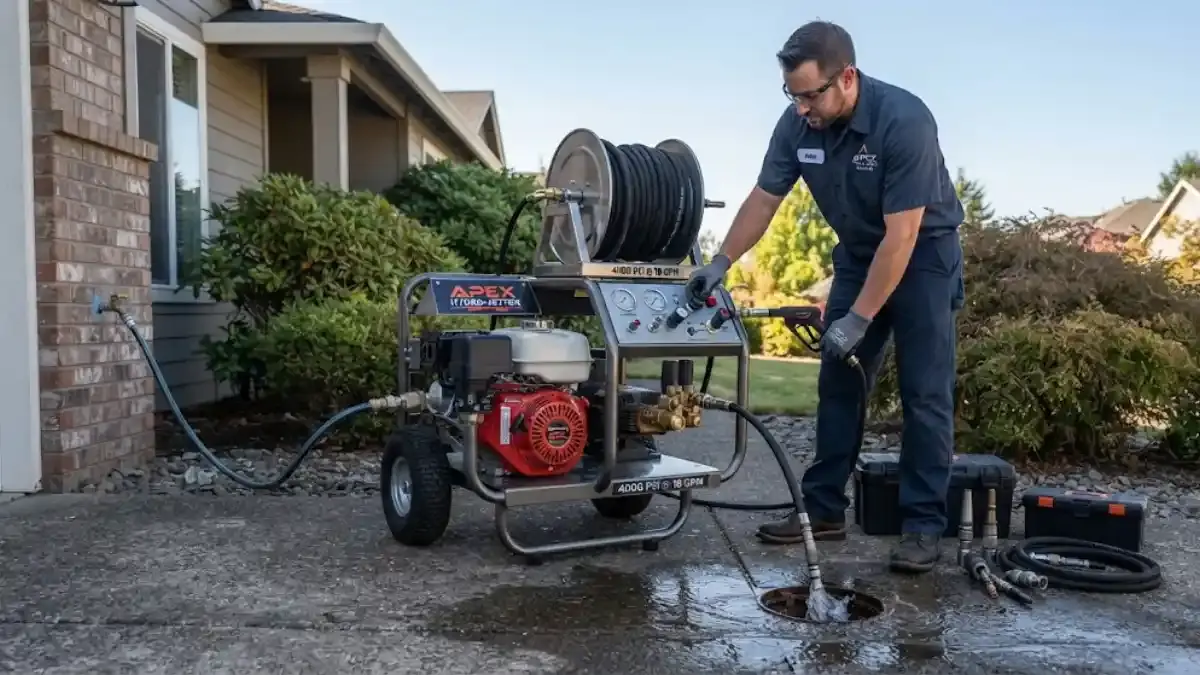
If water is already rising in a tub, shower or basement floor drain, stop using every fixture and keep people away from the wet area. Jetting is not always the first move, so the dispatcher asks what is backing up and where before sending anyone. Same-day appointments are available when the line is slow rather than flooding, and nights, weekends and holidays are covered for backups.
Backing up again weeks after a cleaning? Start here
A single clog is bad luck. A clog that returns in a few weeks is information. It usually means the last visit opened a channel through the blockage without removing the layer that caused it.
People describe the pattern in similar ways. The kitchen line drains well for a short while, then slows again. The basement shower gurgles whenever the washing machine empties. A plunger works, but only for a day or two. Every one of those points to buildup on the pipe wall rather than a one-time object stuck in the line.
That is the job jetting does well. Instead of punching one hole, it washes the whole inside surface, so the pipe regains most of its working diameter.
Signs a jetter is worth considering
- The same fixture or main line has clogged two or more times in a season.
- A cable machine cleared it, but water drained slowly even afterward.
- Several fixtures gurgle or drain sluggishly together, especially on laundry day.
- Cleaning brought out grease, hair mats or fine root threads rather than a single object.
- A camera or a previous plumber described scale or heavy buildup on the pipe wall.
- A restaurant-style kitchen load, such as heavy home cooking or a basement kitchen, feeds the same line.
Jetting compared with cabling
Both methods clear a blockage, and neither is better in every case. A cable is faster and cheaper for a plain obstruction. Water is better when the pipe itself is coated.
| Question | Cable machine | Hydro jetter |
|---|---|---|
| How it works | A spinning steel cable with a cutting head bores through the clog | A hose with a nozzle sends water at high pressure against the pipe wall |
| Best for | A single obstruction, a hair mass, a toy or wipe wad | Grease layers, scale, silt and fine root hair along the whole run |
| What it leaves behind | A channel, with some residue still on the wall | A cleaner wall with the debris flushed downstream |
| Risk to old pipe | Cable can scratch or catch at a bad joint | Pressure can stress cracked, thin or offset pipe |
| When we choose it | First tool for most backups | After a camera shows the pipe can take it |
Why the camera goes in before the nozzle
We do not jet blind. A drain camera shows what the blockage is made of and what condition the pipe is in, and that decides everything else. Fat and scale look different from roots. A cracked clay joint looks different from a smooth plastic coupling.
Jetting a pipe that has a hidden crack can push water and debris into the soil around it. Seeing the wall first costs a few extra minutes and prevents that. If the footage shows damage, the conversation changes from cleaning to sewer line repair, and we will explain why before any pressure goes into the line.
What the jet is removing: grease, roots and scale
Grease and soap. Cooking fat cools inside the pipe and hardens into a wax-like coat. Bath soap and hair join it lower in the system. A rotating nozzle with a wide spray shears this coat off and carries it away.
Roots. Fine roots enter through joints looking for moisture and grow into hair-like mats. A cable can chop the middle out of a mat, but the roots regrow quickly from what remains. A jetter with a cutting nozzle removes more of the mat, though roots in a joint that is open will return unless the joint is repaired.
Scale. Minerals and rust leave a rough, crusty lining, especially in older iron pipe. North Salt Lake’s 2024 water quality report lists total dissolved solids of 888 to 980 mg/L, which is high mineral content. That does not prove scale in any one house, but it is one more reason a camera is worth running before assuming the pipe is clean.
Clog back again this week?
Call the 24/7 line and describe the pattern. We will tell you what to stop using while a plumber is on the way.
Nozzles and pressure in plain terms
A jetter has two main settings, water pressure and flow. Pressure gives the cutting force. Flow carries the debris out. A good operator adjusts both to the pipe, not the other way around.
Nozzle shape matters as much as pressure. A forward-facing penetrating nozzle drills through a hard plug so the other nozzles can work. A rotating or multi-jet nozzle sprays backward and sideways to scrub the wall while pulling the hose forward. A root-cutting nozzle spins a narrow stream to slice fibrous growth. Household lines use lower settings than city mains, and a plumber steps up gradually and watches the camera.
When jetting is the wrong tool
Jetting does not suit every pipe. Orangeburg, a tar-paper-and-pitch pipe used in mid-century homes, can deform or collapse under pressure. Clay with offset or cracked joints can wash out the bedding soil around it. Thin-wall or heavily corroded cast iron can open along rust-weakened seams.
If the camera shows any of these, we will recommend a gentler cable pass or a repair plan, and we will say so plainly. Hydro jetting also needs a way in, such as a cleanout, so a house without one may need a fixture pulled first. We do not jet a line that has an active collapse, because the result can be a sinkhole in your yard.
How a jetting visit goes
Questions first
We ask which fixtures are slow, what was done before and how often it returns.
Camera pass
We inspect the line, note the buildup and rule out damage that would make jetting unsafe.
Stepped jetting
We start with a low setting, work up to the pipe’s limit and clear back toward the cleanout.
Second look
We re-run the camera to show the wall and confirm the line is open before we leave.
Older west-side homes versus Foxboro
North Salt Lake’s first wave of homes was built from about 1910 to 1960 west of Orchard Drive and east of Main Street, according to the 2013 General Plan. Drains from that era may be clay, cast iron or Orangeburg, so if your house is in that area, expect the camera to come first and the jetter second.
Foxboro was built from 2000 to 2010, and its smooth plastic drains usually take jetting well, so a repeat clog there more often points to a sag or a grease habit than to old material.
For ordinary clogs that have not repeated, drain cleaning is faster and costs less. If the problem sits in the larger line out to the street, sewer line cleaning covers cleanouts and the district side of the line. We also reach homes just north of the city, and our Bountiful page explains how that coverage works.
What changes the price of jetting
We give you a clear price before work starts. These are the usual factors:
- The length and diameter of the line being cleaned.
- How hard the buildup is, since scale takes more passes than soft grease.
- Whether a cleanout is available or something has to be removed to get access.
- Whether a camera inspection is added, before and after.
- The hour, because nights and holidays cost more to staff.
Homeowners insurance generally covers sudden and accidental damage, not wear and maintenance. If a backup soaked a finished basement, ask your insurer whether sewer or water backup coverage is on your policy.
Frequently asked questions
Yes. The line is answered 24/7. If sewage is rising in a floor drain at 2 a.m., the plumber assesses the line with a camera first and may clear it with a cable to stop the flooding, then recommend jetting once the situation is stable.
It depends on the pipe. Cast iron in good condition and plastic handle it well. Orangeburg and cracked clay may not. That is why we run a camera before we choose pressure.
A cable cuts a hole through the blockage. A jetter cleans the whole wall. If a drain keeps clogging soon after cabling, the wall buildup is probably the cause.
Not by itself. It clears the roots that are inside the pipe, but if they entered through a cracked joint, they will return. A repair at that joint is what ends the cycle.
Done correctly on sound pipe, it does not. If the camera shows a crack or collapse, we stop and discuss repair instead.
Stop running water, don’t flush, and keep children and pets away from the wet floor. Skip chemical cleaners, because they sit in standing water and complicate the work.
Cleaning an existing line normally does not. Replacing or moving pipe does, and those permits go through the North Salt Lake Building Department at 10 E Center Street.