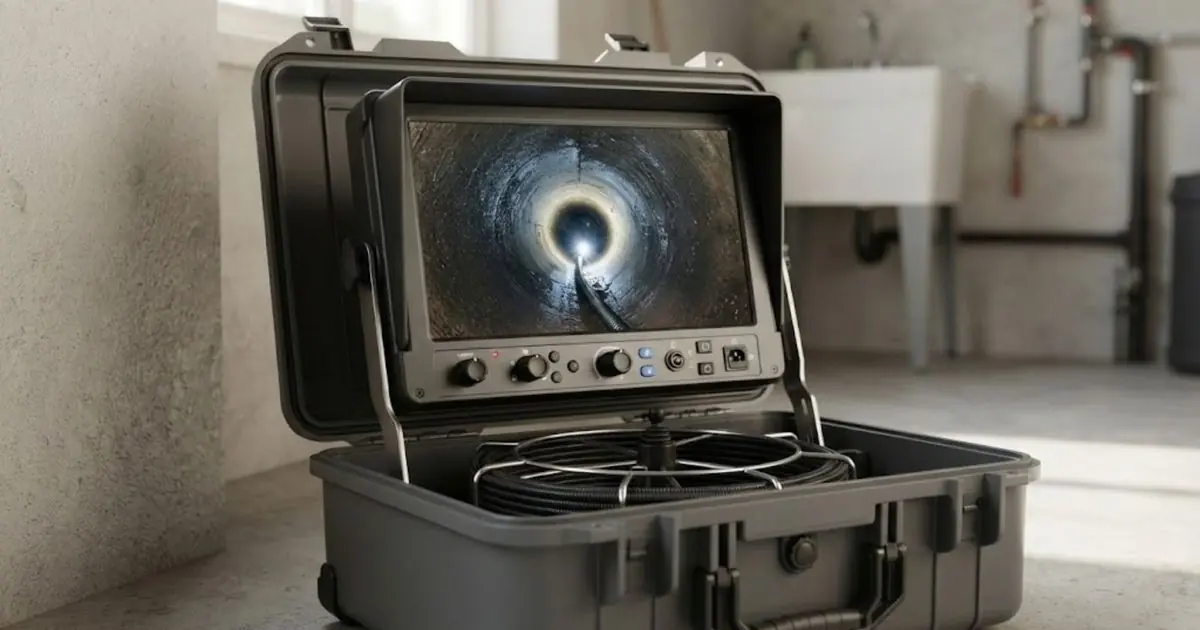
The camera is a small waterproof lens on a flexible rod, pushed through a cleanout or fixture opening. It records as it travels, and a locator in the head lets us mark the pipe’s depth and position above ground. Most homeowners call because of repeat clogs, a house they plan to buy, or a repair estimate they want to check.
What the video can and cannot show
A camera shows interior conditions: cracks, open joints, roots, buildup, offsets and low spots. It does not show what soil surrounds the pipe or whether a problem will worsen. Understanding both sides keeps expectations honest.
| What we look for | How it appears on video | What it means |
|---|---|---|
| Roots | Fine threads or thick mats at a joint | Water is escaping or entering at that point |
| Cracks | Dark lines along or around the pipe wall | The pipe is failing, and the crack may widen |
| Offset joint | A step where two sections no longer line up | Soil movement or a poor connection, which catches paper |
| Belly or sag | Standing water in a section of the pipe | Solids collect there, so clogs return |
| Scale and grease | Rough or crusty lining that narrows the pipe | The pipe needs cleaning, and perhaps hydro jetting |
| Collapse | The pipe is crushed, oval or blocked completely | Replacement is likely |
A belly can fool the picture, because standing water hides the pipe at the bottom. We note it and mark the location rather than guessing at what lies below the surface.
Using a camera before you buy a house
A pre-purchase sewer inspection is one of the most cost-effective checks you can make on an older home. A general home inspector will usually flush a toilet and run a few taps. That does not test the pipe running under the yard to the street.
If the sale is moving fast, call early. We can inspect the line, give you the footage and a written summary, and tell you whether we saw nothing, something to watch or something that affects price. A seller who learns of a problem before closing may fix it or adjust the price. A buyer who learns afterward pays for it.
If you are buying in North Salt Lake, the age of the house changes how much weight the camera deserves. The 2013 General Plan places the first wave of homes between about 1910 and 1960, west of Orchard Drive and east of Main Street. Laterals from that period may be clay, cast iron or Orangeburg, and original pipe has had many winters to crack and shift.
In that area, we treat an inspection as close to essential. Foxboro was built from 2000 to 2010, so its plastic lines are younger, and the inspection there is mostly to confirm there is no sag, bad joint or construction debris.
What a visit looks like
Find the access
We locate the cleanout, or if there is none, a fixture or vent we can use.
Run the camera
We push the camera down the line and record the footage with distance counts.
Mark the findings
We use the locator to note the position and depth of anything we see.
Review it with you
We play back the video, explain it and tell you what, if anything, needs action.
Locating a line when you do not know where it runs
Many owners do not know the path of their lateral, and fences, patios and new landscaping get planned without that knowledge. The camera head sends a signal that a receiver can detect above ground, so we can paint or flag the route and depth on the surface.
That is useful before you dig, plant a tree, pour a patio or build an addition. It also helps when a repair is needed, because the exact location limits how much has to be excavated. Locating a sewer line does not replace calling 8-1-1 before you dig, which marks the utilities.
Want to see the pipe before you decide?
Call our dispatch line to schedule a camera inspection. Same-day appointments are available when the schedule allows.
What our report covers
You leave with more than a verdict. The report lists:
- The line material and size if we can see them.
- The total length inspected and how far from the cleanout each finding sits.
- Cracks, roots, offsets, bellies, buildup or collapse.
- A recommendation: no action, monitor, clean, line or replace.
- The video itself, so you can show it to another contractor or the seller.
If the pipe is sound, the report says so, and we do not suggest work it does not need.
How the footage supports a repair decision
Footage is the basis for choosing between spot repair, lining, pipe bursting and a trench. A single cracked joint might need a small pit and a short replacement. A long run with several rooted joints may suit lining. A collapsed section will likely need a dig. Our sewer line repair page explains how those methods compare.
Sometimes the video shows the opposite, a healthy pipe that only needs maintenance. In that case, sewer line cleaning on a schedule may solve the problem without any digging. If you want a second opinion on a quote another company gave, bring us the quote and we will tell you what the camera shows. Buyers closing on a home in Centerville or Bountiful can reach the same dispatch line, and our Centerville page explains the coverage.
What affects the price of an inspection
We give you a clear price before work starts. The main factors are:
- Whether a cleanout exists or we need to pull a toilet or use another access point.
- The length and complexity of the line.
- Whether the line needs cleaning first so the camera can see.
- Whether you want locating and marking on top of the video.
- The urgency of the appointment.
Insurance rarely pays for an inspection by itself. If the footage reveals sudden damage, ask your insurer what they need as documentation.
A camera is not a code inspection
A sewer camera inspection is a diagnostic service, not a municipal inspection. New sewer laterals and added fixtures in North Salt Lake involve the South Davis Sewer District, whose inspector inspects work with about four hours of notice, and the city Building Department handles plumbing permits at 10 E Center Street. If your plan involves new work, the camera can help design it, but the permit and district steps still apply. We can explain how that sequence runs.
Frequently asked questions
The visit usually runs about an hour for a standard residential line, longer if the pipe needs cleaning before the camera can see. We confirm timing when you call.
No. The camera goes in through a cleanout or fixture. Digging comes only if you later choose a repair that needs it.
For a house built before the 1960s, yes. The first wave of homes sits west of Orchard Drive, and the original sewer line may be old clay or iron. Even a newer home can have a sag or a bad joint.
Often yes. We can use a toilet, a floor drain or a roof vent. It takes more time, and we will tell you before we start.
Yes. You receive the footage and our written findings, which you can share with a seller, an agent or another contractor.
We explain the choices and the likely range of cost factors, and you decide. There is no obligation to hire us for the repair.
Our camera runs through your own lateral. If the footage points to trouble at the connection to the main, we tell you, and the South Davis Sewer District can respond to its side.