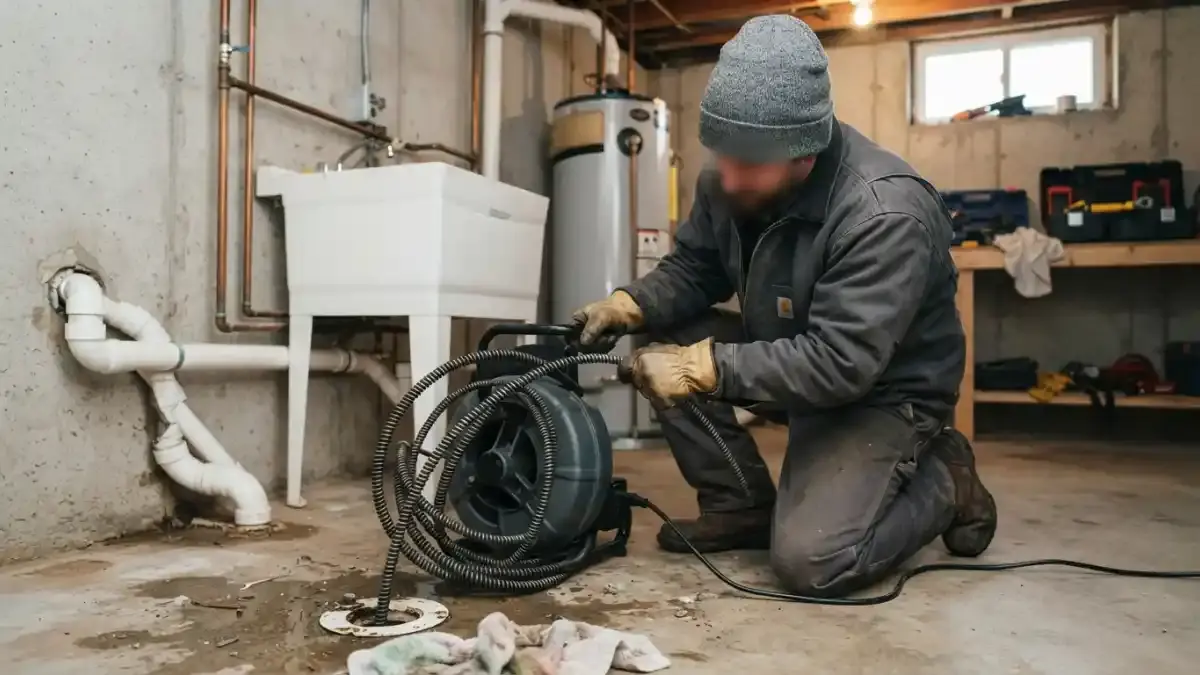
A sewer backup is a health matter as well as a plumbing one, so treat the water as contaminated. Stop using every fixture, keep children and pets out of the room and leave the drain alone. Same-day appointments are available for slow lines, and nights, weekends and holidays are covered when sewage is already on the floor.
Sewage coming up in the basement shower or floor drain
When the main line blocks, water follows gravity. It rises first in the lowest opening in the house, which is usually a basement floor drain, a basement shower or a laundry standpipe. Upstairs fixtures may still seem fine at first, then gurgle or drain slowly as the line fills.
If your basement is finished, the stakes go up. Carpet, pad, baseboard and the bottom of drywall soak fast, and each hour matters for drying. Move valuables off the floor if you can do it without stepping into the water. Do not run a vacuum or any electrical equipment in a wet area. If water is near outlets or the panel, stay out and call.
Do not wait overnight to see if it drains. A line that is blocked at a root mass or a collapse will not clear itself, and every load of laundry upstairs adds water to the problem.
What to do while you wait for the plumber
- Stop running water in every fixture, including the dishwasher and washing machine.
- Do not flush toilets, even if they seem to work.
- Keep children and pets away from standing water.
- Leave floor drain covers and cleanout caps in place until the plumber arrives.
- Skip chemical drain cleaners, since they sit in the pipe and splash back toward whoever works on the line.
- Photograph the water level and affected areas for your insurer, from a dry spot.
- Clear a path to the basement and, if you know it, to the cleanout.
Symptom, likely location and next step
| What you notice | Where the blockage likely is | What happens next |
|---|---|---|
| One sink or tub drains slowly, everything else is normal | The branch line serving that fixture | A drain cleaning with a small cable |
| Basement shower or floor drain backs up when you do laundry | The main line | A cable from the cleanout and a camera follow-up |
| Toilets bubble when the washer drains, and upstairs drains are slow | Main line, partly blocked | A larger cable machine, often with jetting afterward |
| Repeated backups every few weeks | Roots, a belly or a damaged joint | Camera inspection, then a decision about repair |
| Backup plus a sunken patch or wet spot in the yard | Cracked or collapsed pipe | Camera and likely sewer line repair |
Where the cleanout is, and why it matters
A cleanout is a capped pipe that gives a plumber direct access to the sewer line without pulling a toilet. Every minute spent looking for one is a minute the water keeps rising, so it helps to know where yours is.
In many houses it sits outside, near the foundation, close to where the line leaves the building. It looks like a short 3 or 4 inch pipe, capped with a round plug, sometimes in a small box in the lawn or flowerbed.
In others it is in the basement near the main stack, in a crawlspace or a utility room, or beside the water heater. Newer homes often have two. Older houses may have none, and then access comes through a toilet, a roof vent or a floor drain.
Do not open a cleanout during a backup unless a plumber tells you to. Standing water above the cap will pour out the moment it loosens.
Why a full main line backs up the way it does
The main sewer line is the pipe that collects every drain in the house and carries it to the district’s collector. When it blocks, nothing downstream can empty, so the pipe fills back through the branch lines. That is why a backup rarely stays in one fixture.
The cause is usually one of four things: grease and wipes that built up over time, tree roots, a sag where water pools and drops solids, or a broken section. Cleaning clears the first two. The last two come back until the pipe is fixed. A camera after the cleaning shows which one you are dealing with, and for stubborn buildup we may follow with hydro jetting.
Drain pipe cleaning when the problem is further up the line
Not every sewer problem starts at the main. A bathroom group that shares a branch can clog without affecting the kitchen, and the branch might need separate attention. We clear drain pipes throughout the house, from a tub trap to the stack, and we check that the main is free before we pack up. For a plain single-fixture clog, drain cleaning is the page to read.
Backup in the basement right now?
Call the 24/7 line and tell us which drains are affected. We will walk you through what to switch off until the plumber arrives.
Who owns what, and what the sewer district does
Sewer service in North Salt Lake is provided by the South Davis Sewer District, which can be reached at 801-295-3469. The district office is at 1800 W 1200 N in West Bountiful. It requires impact fees before a new lateral or added fixtures go in, and its inspector inspects new laterals with about four hours of notice. The city building permit does not include the district’s fee.
What the city page does not say is where the district’s responsibility ends and the homeowner’s begins. If the camera shows the blockage sits in the public main rather than your house line, we tell you and you can call the district to ask. Our job is to find which side of the connection the problem is on.
Older pipe west of Orchard Drive, plastic in Foxboro
The 2013 General Plan describes a first wave of homes built from about 1910 to 1960 west of Orchard Drive and east of Main Street. Houses from that period may have clay or cast-iron sewer lines with roughened walls and open joints, so root growth is a common cause of a repeat backup.
A camera after cleaning in one of these homes is worth the extra visit, and a sewer camera inspection can be booked on its own. Homes in nearby Woods Cross are reached from the same line, as our Woods Cross page explains.
Foxboro was built between 2000 and 2010, mostly with smooth plastic pipe. A backup there is more often a wipe or grease blockage, or a sag from settling, than a rooted joint. A single cleaning often ends it.
What changes the price of cleaning a sewer line
We give you a clear price before work starts. The main factors are:
- How far the blockage sits from the cleanout and how much cable it takes to reach it.
- Whether a cleanout exists or access has to be created.
- The pipe size and whether the line needs a larger machine or a jetter.
- Whether a camera pass is added to prove the cause.
- Whether this is a first backup or one of several, since repeats point toward repair.
Homeowners policies usually cover sudden and accidental water damage, not maintenance or wear. Sewer backup coverage is often a separate add-on, so ask your insurer what yours includes before you file.
Opening a cleanout safely
Plumbers stand to the side of a cleanout cap and loosen it slowly. Backed-up lines hold water under head pressure, because the pipe is full back to the lowest fixture, and a quick twist can send a surge out. If you must check a cap yourself, use gloves and leave it closed until help arrives. A strong sewer gas smell with dizziness means leave the house and call 911.
What happens when we arrive
Find the flow
We test fixtures to see which are affected and locate the cleanout.
Clear the line
We run a cable of the right size and cut through the blockage.
Camera pass
We look at the pipe to see roots, sags or breaks that could bring the clog back.
Explain the options
You get the footage, a plain explanation and a price for any repair.
Frequently asked questions
Yes. The line is answered 24/7, holidays included. For a backup, tell the dispatcher which drains are affected and whether water has reached finished floors, so the plumber arrives with the right machine.
It depends on the policy. Standard policies often exclude sewer backup unless a rider was added. Ask your insurer, and photograph the damage before cleanup starts.
A hardware-store auger can reach short branch lines, but a main line is longer and can have roots or breaks. Utah also limits what homeowners may do themselves, so check with the Building Department and DOPL before changing any piping.
If neighbors on the same street have backups too, or the camera shows the line is clear up to the connection, the district’s main may be involved. The South Davis Sewer District can respond to that side.
The smell fades after the line is clear and the area is cleaned and dried. A lingering odor may mean sewage soaked into flooring or drywall, and a restoration company can advise.
Yes. That pattern usually means a blockage in the main line, since water is finding the next lowest opening. Stop water use and call.
Sewer service in the city is through the district, so the typical North Salt Lake home has no septic system. If yours does, call and describe it so we can say what we can and cannot do.