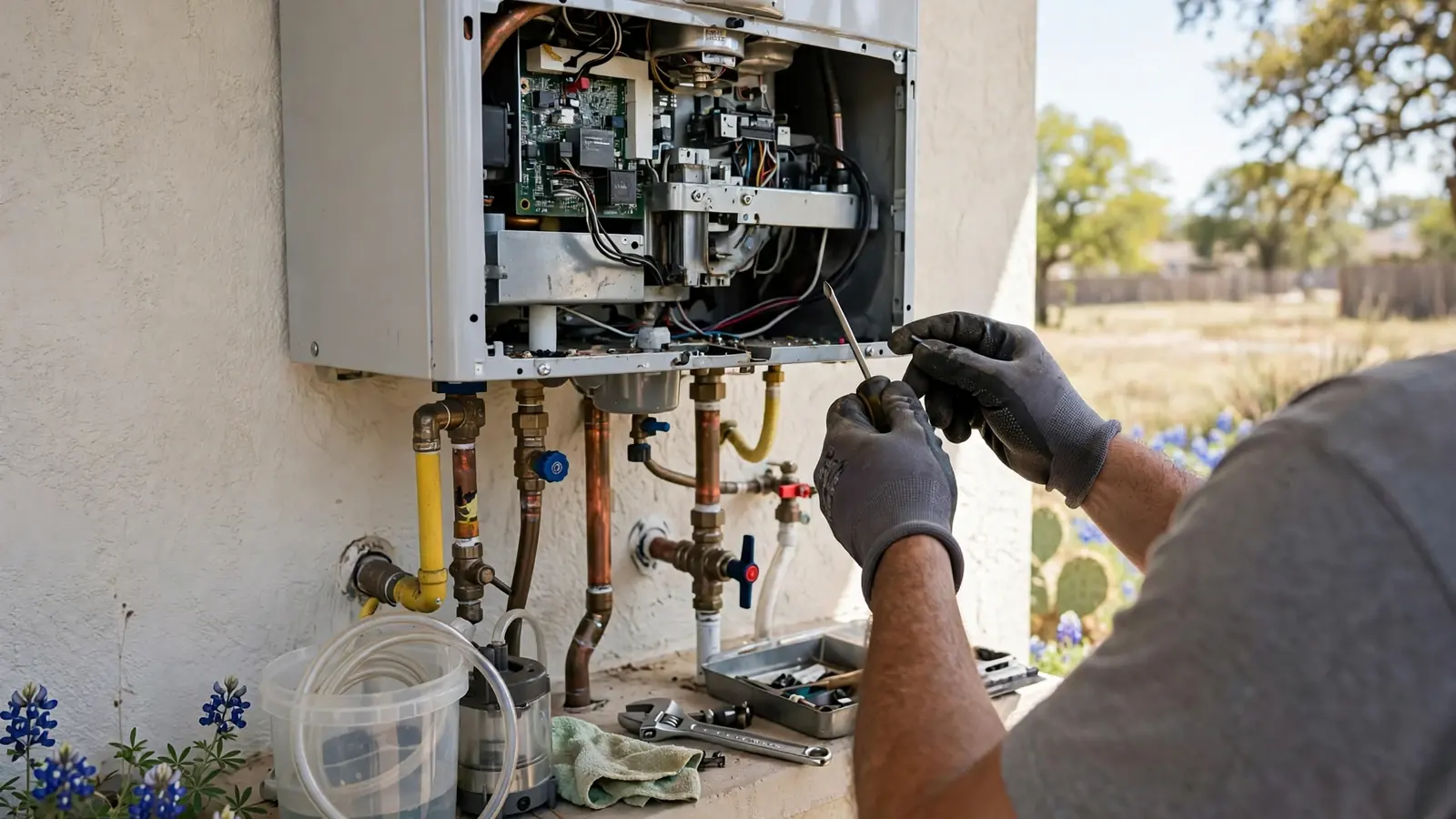
The vent is what makes a gas tankless swap more than a like-for-like change. A tank heater usually exhausts through a chimney. A tankless unit often cannot use the old one, so the vent decides the cost, the location and whether the install is allowed.
Gas versus electric: the short answer
A gas tankless unit burns fuel at the burner and pushes combustion gases, including carbon monoxide, through a vent pipe to the outside. A leak in that vent puts exhaust in the house, so the vent is a safety part, not an accessory.
An electric tankless unit heats water with elements. It has no exhaust and needs no vent, but it draws a large amount of current, and the panel and wiring decide whether it fits. Gas units vent, electric units do not, and both need a plumber to size the water and fuel lines.
Condensing and non-condensing: why the vent material changes
Non-condensing tankless heaters are roughly 80% efficient and send out hot exhaust. According to Plumbing & Mechanical magazine, that exhaust calls for metal venting, usually stainless steel. Condensing units pull more heat from the exhaust, reach roughly 95% efficiency and release cooler exhaust that can go through plastic such as PVC or polypropylene.
Condensing units make acidic condensate. That liquid must drain to a proper receptor, so a condensing install needs a drain nearby and, in some cases, a neutralizer. The manufacturer’s manual tells you which vent materials the unit is listed for. Using something else voids the listing and can be unsafe.
Direct vent versus power vent
Venting also depends on where the unit gets its combustion air.
| Type | Combustion air | Vent runs | Best for | Watch for |
|---|---|---|---|---|
| Direct vent | Outdoors, through a second pipe or a concentric pipe | Intake and exhaust, often through a side wall | Closets, small rooms, tight homes | Two penetrations, or one larger concentric pipe |
| Power vent (indoor air) | From the room | Exhaust only | Large rooms with enough air | Needs enough room volume or louvers |
| Condensing PVC | Usually direct vent | Plastic pipe, short sloped runs | Homes where the unit sits far from an exterior wall | Condensate drain and slope |
| Non-condensing stainless | Direct or indoor air | Stainless pipe, sealed joints | Replacements of older, hotter units | Higher material cost, clearance to combustibles |
| Electric, no vent | None | None | Where the panel can supply the load | Amperage and wire size |
What the manufacturer and the code decide
Each model has a listed vent length, a maximum number of elbows, an approved material list and clearances to windows, doors and other openings. Those numbers differ by model. The installation manual is the rule for that unit, and the local code authority enforces it.
That is why this guide stays general. A plumber reads your unit’s manual, measures the run from the heater to an exterior wall and counts the elbows before quoting. A vent that is a foot too long or has one elbow too many can fall outside the listing.
Common vent problems we see in swaps
- A chimney that is too large or damaged for a smaller unit’s exhaust.
- A vent that runs too far or with too many elbows for the model.
- A termination too close to a window, door, gas meter or air intake.
- A condensing unit with no condensate drain nearby.
- An outdoor vent exposed to snow or ice at the termination.
- Joints that are not sealed or supported as the manual requires.
Rain, snow and frost matter on the wall side. According to the city, the winter design temperature in North Salt Lake is 8 F, and the footing frost depth is 30 inches. Both numbers bear on where the vent exits and how the condensate line is protected, since a condensate trap that freezes stops the unit.
Gas smell near the heater?
Leave the building and call Enbridge Gas at 1-800-767-1689 or 911 first. Then call our 24/7 line.
Carbon monoxide and the vent
A gas tankless heater with a failed vent joint can leak carbon monoxide into the home. Working CO alarms near sleeping areas are a sensible backup for any gas appliance. If an alarm sounds, get everyone outside and call 911 or the gas emergency line before you try to find the cause.
After an install, ask the plumber to show you the vent joints, the termination and the condensate path. A good installer walks the whole run with you and tests for leaks before leaving.
Gas line and sizing: the part that surprises people
A tankless unit demands a large burst of gas for a short time. A line sized for a tank heater may be too small. The plumber measures the pipe from the meter, counts the other gas appliances and checks the capacity. If the line is short on capacity, the upgrade adds cost and may need a permit.
Our tankless water heater page covers the broader picture of sizing and installation. If you are switching from an older tank heater, the water heater installation page explains the permit and inspection steps that apply to any new gas appliance.
North Salt Lake notes for tankless venting
Gas service is from Enbridge Gas, formerly Dominion Energy Utah. The gas emergency number is 1-800-767-1689, and 911 works from a safe distance. If you smell gas, leave the building before calling.
Plumbing permits are issued by the Building Department at 10 E Center Street through City Inspect. The city’s quick-facts sheet lists a $50.50 over-the-counter fee for plumbing permits, with inspections Monday to Thursday. A new vent and gas line change are work to ask about.
Utah’s plumbing code is the 2024 International Plumbing Code (IPC) from July 1, 2026, and Utah’s amendment requires water heaters to be anchored or strapped. For tankless units that hang on a wall, the manufacturer’s mounting instructions govern.
Nearby towns
We dispatch from North Salt Lake to Woods Cross and Centerville on the same 24/7 line. The vent rules above follow the manufacturer wherever the home is.
Frequently asked questions
No. It has no flame and no exhaust. It does need adequate electrical capacity and proper clearances from the manufacturer.
Sometimes, but often not. Chimneys are sized for tank heaters, and a condensing unit cannot use one at all. The manual and a plumber’s inspection decide.
Only for units the manufacturer lists for it, which are usually condensing models. Non-condensing units generally need stainless steel. Follow the manual.
It pulls combustion air from outdoors through a separate pipe or a concentric pipe and sends exhaust outside the same way. It does not use room air.
A new vent, a gas line change and a new gas appliance are work to ask the Building Department about. Plumbing permits are issued at 10 E Center Street.
Cold matters. The city’s winter design temperature is 8 F, so a unit, its condensate line and its vent termination need freeze protection. Check the manual’s allowed ambient temperature.