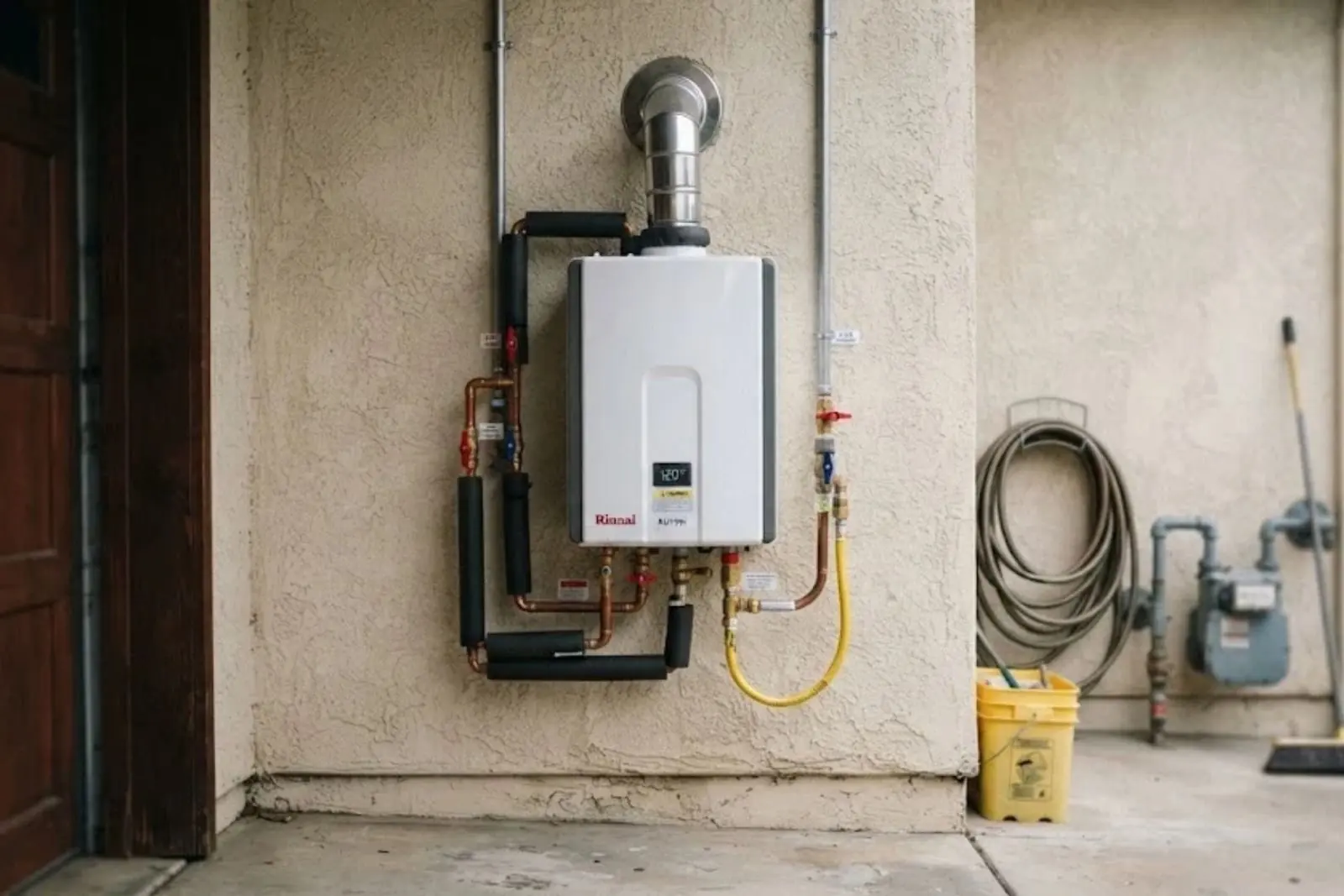
If a tankless heater is leaking or you smell gas, shut off the water and gas to the unit and call. For a gas smell, leave the house and call Enbridge Gas (formerly Dominion Energy Utah) at 1-800-767-1689, or 911 first. For anything less urgent, we can book a same-day appointment when one is open.
Flushing and descaling a tankless heater
An on-demand heater runs water through a narrow heat exchanger at high temperature. Minerals in that water settle out on the hot metal as scale, and scale insulates the exchanger, restricts flow and triggers error codes. The result is lukewarm water, a unit that cycles on and off or a display that shows a fault.
The city’s 2024 water quality report lists total dissolved solids between 888 and 980 mg/L. That is high mineral content, so descaling matters, and a tankless owner in North Salt Lake should not skip it. We do not claim a hardness number, because the report does not give one. We can test your tap and tell you what we see in the unit.
A flush connects a pump and a food-safe descaling solution to the service ports on the heater and circulates it through the exchanger, usually for 45 to 60 minutes. We then rinse, clean the inlet filter and check that flow and outlet temperature are normal. Flushing yearly is common advice, and more often if your unit has shown trouble. Many manufacturers require a flush record to honor a warranty, so keep the date.
You can ask us to handle the isolation valves too. A unit with no service valves can still be flushed, but valves make future flushes quick, and adding them is a small plumbing job.
Tankless symptoms and what causes them
Error codes differ by brand, so the table speaks in general terms. Your manual will name the exact code.
| What you notice | Common cause | Usual fix |
|---|---|---|
| Water never gets fully hot | Scale in the heat exchanger or low gas supply | Descale, check gas pressure |
| Hot water turns cold for a second | Flow below the minimum needed to fire | Clear inlet filter, check fixtures |
| Unit shuts off with a code | Blocked vent, scale, flame sensor fault | Clean, test sensor, inspect vent |
| Condensation drips below | Blocked condensate line or neutralizer | Clear line, replace media |
| Sudden leak under the unit | Cracked exchanger or loose fitting | Shut off and call |
| Long wait for hot water | Distance from heater to the tap | Recirculation line or small buffer |
How a tankless installation differs from a tank swap
A tankless heater makes large amounts of heat in a short time. A gas model draws far more gas than a tank burner, often requiring a larger gas line than the old heater used. We calculate the demand from all appliances on the line, then check the meter and pipe size. A line that is too small starves the unit, and the water runs cold during peak use.
Venting also changes. High efficiency units exhaust cool gases and need plastic vent pipe and a condensate drain. Others need stainless vent. The route, slope and termination spot all matter, and the manufacturer’s instructions govern. We follow them and the plumbing code, then schedule the permit inspection. Planned installs are covered in more detail on our installation page.
Minimum flow is the other surprise. Most tankless units will not light until the water moving through them passes a threshold. A trickle from a low-flow tap or a half-open faucet may not fire the burner. We explain that on every install, so your expectations match the unit.
Venting and gas line sizing in plain terms
Think of the gas line as a pipe that has to supply the burner at full fire. The length of the run, the pipe size, the number of fittings and the other appliances on the same line all take a share. A good install lists them and checks that the line delivers enough. We do this on paper before we order the unit.
Vent size follows the same logic. The vent must carry exhaust out without leaks or backdraft. A sagging section holds condensate. A long run with many elbows can exceed the allowed length. Both cause error codes, and both are easy to prevent when planned in advance.
Cold spots or error codes?
Call the line, read us the code on the display and tell us how old the unit is. We will plan the right visit.
Why error codes come back
A code that clears after a reset and returns a week later is not a ghost. It is usually one of four things: scale on the exchanger, a dirty flame sensor, a clogged inlet screen or a vent or condensate problem.
Resetting the unit tells you nothing about the cause. A service visit tests each of these in turn. If the code persists after cleaning, the board, a fan or a sensor may be at fault, and replacement parts depend on the brand.
When we repair and when we replace a tankless unit
Most tankless problems are repairable. Scale, sensors, fans, igniters and filters are all serviceable.
Replacement enters the picture when the exchanger has cracked from freeze or scale damage, when parts are no longer made for an old model or when repair cost approaches that of a new unit. We tell you honestly where yours stands. If a tankless heater is not meeting demand in a large household, adding a second unit or swapping to a tank replacement can be the more sensible choice.
Tankless heaters on exterior walls can freeze in cold snaps. The city’s design criteria list a winter design temperature of 8 degrees F, so a unit in an unheated space or a vent exposed to wind deserves protection. We point out freeze risks during any visit.
Repair calls and who to call first
For a leaking unit, shut off the water supply and the gas valve, then call.
For a plain loss of hot water, check that the gas valve and the water valves are open and that the unit has power. Tankless heaters rely on electricity for the fan and controls, so a tripped breaker or a power outage stops them even on a gas model. If you have a water heater repair problem that is not tankless, that page covers tank units.
What changes the price of tankless work
We give a clear price before work starts. These factors matter most:
- Whether the job is a service flush, a repair or a full installation.
- Gas line upsizing, new venting and condensate drain requirements.
- Unit size, brand and whether it is condensing.
- Access to the service ports and the wall or location of the unit.
- Parts availability for older models.
Frequently asked questions
At least once a year is the common guidance. The city’s 2024 water quality report shows total dissolved solids between 888 and 980 mg/L, so we lean toward a regular schedule and a check after any performance change.
Not in the sense of a tank, but it can reach its flow limit. Running several showers and a dishwasher together may exceed what one unit can heat.
Installation does. Permits go through the North Salt Lake Building Department at 10 E Center Street, and Utah limits what homeowners may do themselves.
Not normally. The controls and fan need electricity, so a standard gas tankless heater will stop. A battery backup can be added in some setups.
It depends on how many fixtures run at once and how cold the incoming water is. We calculate it from your home, not a rule of thumb.
Many last well beyond a tank when serviced regularly. Neglected units tend to fail early from scale.
Yes. The same line reaches Centerville and neighboring cities. Ask the dispatcher about your address.