If your heater has already failed and water is leaking, skip this page and read our replacement page, or call the 24/7 line. Planned installs are about doing the work right the first time, so we start with a conversation about where the unit will sit, what it will serve and what the house already has.
Start with the room, not the model
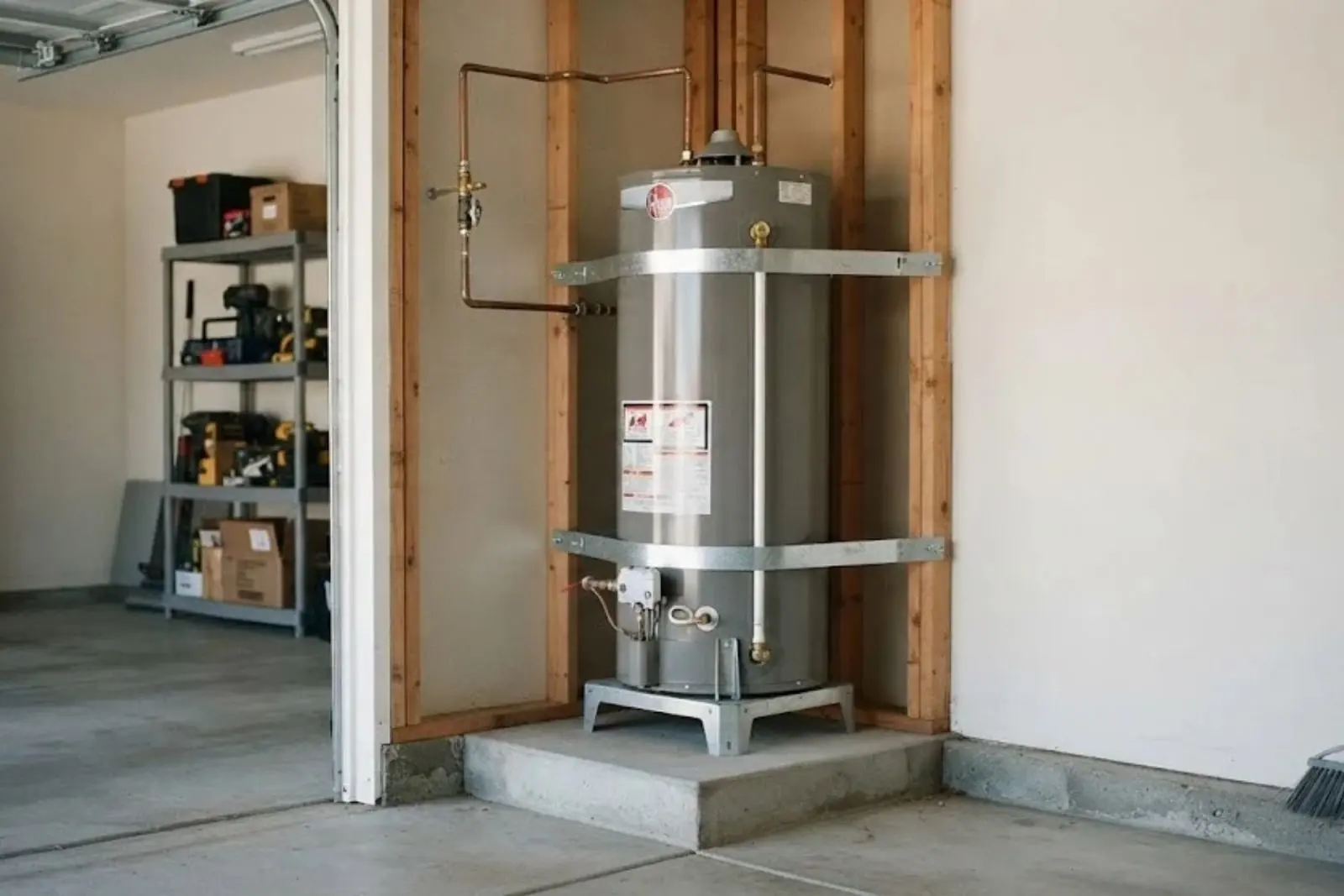
Where a water heater sits decides most of what the job involves. A basement corner near the old unit is the easiest case, because the supply lines, vent and drain are already there. A garage adds questions about vehicle impact and flammable vapors, and gas heaters in garages generally need the burner raised off the floor or otherwise protected. An attic or closet raises access, drain and ventilation problems.
Walk the space with us before you buy. A tall tank may not clear a low ceiling, and a closet may lack the clearance a gas unit needs around it. We measure, check the vent route and tell you whether your first choice fits. That conversation saves more money than any discount on equipment.
Gas, power and the fuel decision
Fuel is usually dictated by what the house already has, and switching is possible but costs more.
| Setup | What the install needs | Common snag |
|---|---|---|
| Gas tank | Gas line sized for the burner, a vent to the outdoors, combustion air | Old vent run too small or poorly sloped |
| Electric tank | A dedicated circuit and breaker sized to the heating elements | Panel with no spare capacity |
| Gas tankless | Larger gas line, stainless or special vent, condensate drain if high efficiency | Undersized existing gas piping |
| Heat pump hybrid | Electrical circuit, airspace, condensate drain | Cramped, closed room |
Gas work is regulated, and Utah limits what homeowners may do themselves. We do not ask you to cap or extend a gas line on your own. If you smell gas at any point, leave the building and call Enbridge Gas (formerly Dominion Energy Utah) at 1-800-767-1689, or 911.
Venting and combustion air in general terms
A gas heater needs two things to burn safely: air to feed the flame and a path for exhaust. Natural draft vents rely on warm exhaust rising through a pipe with a steady upward slope. A tight, sealed room can starve the burner or draw exhaust back into the house. Closets with louvered doors and basements with enough open volume usually work. Utility rooms packed with other appliances sometimes do not.
We check that the vent pipe has the right diameter, rises continuously, joins the chimney or exterior termination properly and has no loose connections. When a new installation moves the heater, the old vent may need to be replaced rather than reused. This matters because carbon monoxide has no smell, and a vent that spills at the draft hood is a danger even if the heater seems to run fine.
Electrical points for electric and hybrid units
An electric tank draws a large steady load, so it wants its own breaker, correct wire gauge and a safe disconnect within reach. A hybrid heat pump unit needs a circuit as well. We confirm what the panel can carry before ordering anything. When the existing panel is full, an electrician may have to add capacity, and we will say so up front rather than discover it halfway through the job.
Expansion tank, pan and drain
Water expands when it heats. In a plumbing system that cannot push the extra volume back into the street main, a small expansion tank absorbs it. Many homes with a closed system, such as one with a check valve or a pressure reducing valve at the main, can benefit from one. We check whether yours is needed and size it for the tank. This is general plumbing practice, so ask us how it applies to your house.
The pan beneath the heater catches slow leaks and gives you time to react. Utah’s amendment allows a pan drain to tie into the waste system only with the code official’s permission, individually trapped and vented, and not connected to a vent. The pan serves that one heater only. Where there is no safe drain path, we run the discharge to an approved point. Skipping the pan in a finished basement is a gamble we do not recommend.
Strapping against earthquakes
Utah’s amendment to the plumbing code requires water heaters to be anchored or strapped to resist horizontal movement in an earthquake, with straps within the upper one-third and lower one-third of the tank.
The city’s own design criteria place North Salt Lake in a high seismic category, depending on how close the property sits to the Wasatch Fault trace. A strapped tank is much less likely to tip, rip free from its gas line or break its water connections. We add straps to every install, and we can retrofit older heaters during a service visit.
Ready to schedule an install?
Call the line, describe where the heater will sit and what fuel is available, and we will set a time for a licensed plumber to visit.
Relocating or upgrading an existing heater
Moving a heater means moving its connections: water lines, gas line, vent, drain and electrical feed. Each move costs labor and materials, and the permit review looks at all of them. A typical reason to relocate is finishing a basement, converting a closet into a laundry or putting a tankless unit on an exterior wall. We map the route on paper first and tell you the plan before cutting into anything.
Upgrading from a tank to tankless or a hybrid adds items. Tankless units need larger gas supply and special venting, which is covered on our tankless page. Some homeowners also pair a new heater with a pressure and shut-off check on the supply side, since a shut-off valve that cannot close is a hazard during any swap.
Permits and who is allowed to do the work
Water heater installation in North Salt Lake needs a plumbing permit from the Building Department at 10 E Center Street. Applications are filed through the City Inspect portal, plumbing permits generally have no plan review, and inspections run Monday through Thursday. Utah limits what homeowners may do themselves, and first-time installation of an appliance is not part of the homeowner exemption. Check with the Building Department and DOPL, and verify any plumber’s license on the DOPL lookup.
Planning a swap before the tank fails
A planned replacement beats an emergency one every time. You choose the unit, the day and the budget. Signs it is time to plan: the tank is about ten years old, sediment noise is growing or small rust spots are showing at the base. A short visit lets us look at the existing setup and write a plan. If you would rather wait for failure, our repair crew can often buy time.
What changes the price of an installation
We give a clear price before work starts. The main factors are:
- Fuel type and unit style, since tankless and hybrid units cost more to buy and set.
- Gas line, vent and electrical upgrades needed to match the new unit.
- Relocation distance and how much wall, ceiling or floor must be opened.
- Pan, drain, straps and expansion tank requirements.
- Permit and inspection scheduling.
Standards a new heater must meet
A new heater is installed to the 2024 International Plumbing Code (IPC) that Utah adopts from July 1, 2026, plus the manufacturer’s instructions. That covers the pan and drain, the temperature and pressure relief line, venting and the strapping amendment. The inspector checks those points, not the brand.
Frequently asked questions
A like-for-like tank swap usually takes part of a day. Relocations, fuel changes and tankless conversions take longer because they involve gas, venting or electrical work.
Yes, after a site check. Tankless needs the right gas sizing and vent route, and heat pump units need airflow and a drain.
Only if a gas line and an approved vent route are available. We look at the route and the meter capacity before quoting.
Yes, on the work we perform. The permit goes through the North Salt Lake Building Department.
We remove and dispose of the old unit as part of the job.
Yes. Our crews reach Bountiful from the same dispatch line.
Call and describe the space. We will tell you which type fits and what the install would involve.