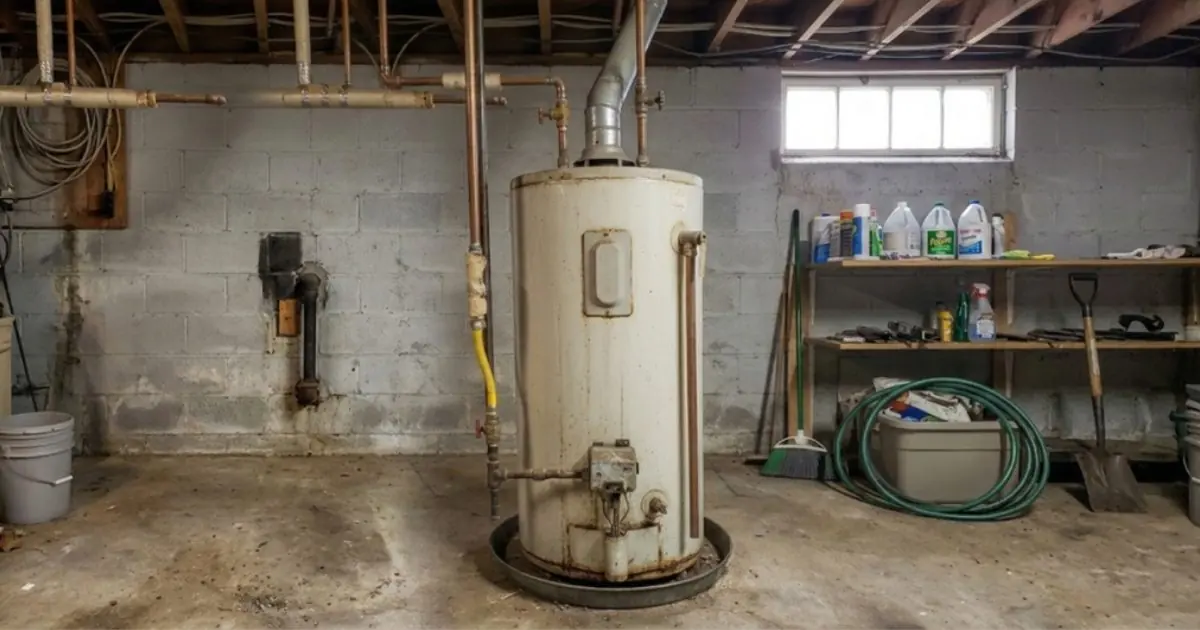
If water is already on the floor, close the cold supply valve above the tank and turn off the gas control or the breaker. Open one hot tap upstairs to ease the pressure, then call. Nights, weekends and holidays are covered, and a replacement can be scheduled for the next available slot when the old heater is still limping along.
Emergency: the tank gave out and there is water on the floor
A water heater fails in one of two ways. Either the heating system quits and the tank stays sound, or the tank corrodes through and water escapes. The second case is the replacement case. Once the shell leaks, the inner lining has failed and the rest of the steel is not far behind.
Look for rust-colored streaks down the jacket, a puddle that returns after you dry it, or water at the base even when every pipe on top is dry. Those are signs the tank itself is done. A drip from a pipe fitting on top is a different problem, and our repair crew will fix that and keep the unit running.
While you wait for the plumber, protect the floor. A heater in a finished basement can soak carpet pad and drywall fast. Wet vacuum what you can, lift boxes onto blocks and keep children away from the hot water that may still be escaping.
Repair or replace? How to decide
Age and symptoms usually settle the question. Here is how we weigh it.
| What you see | Usually points to | Our advice |
|---|---|---|
| Water at the tank base, rust on the jacket | Corroded tank | Replace |
| Tank over about 10 to 12 years with a new problem | End of service life | Replace in most cases |
| Pilot keeps failing, no leaks | Worn thermocouple | Repair |
| One element dead, tank otherwise dry | Failed electric part | Repair |
| Rumbling and short hot water supply | Heavy sediment | Flush or replace by age |
| Second repair in a year on an older tank | Aging unit | Replace |
Signs the tank is near the end
Not every failure arrives as a flood. A tank often gives warnings for weeks before the shell lets go:
- The unit is past roughly a decade and the hot water supply has shrunk.
- Rust-tinted water comes from the hot taps only.
- Drain water at the bottom comes out brown or full of flakes.
- You hear popping or rumbling from sediment baked onto the tank floor.
- Small damp spots keep showing up at the base.
- The anode rod, when pulled for inspection, is eaten down to the core wire.
If three or more of these ring true, planning a swap on your schedule is cheaper than a weekend flood.
No hot water at all
A home with no hot water and a dry floor may need a part, not a new tank. A gas unit with a dead pilot or an electric unit with a failed element is repairable. If the heater is old and the part cost approaches the cost of a new tank, replacement makes more sense. We lay out both numbers on the phone so you decide with the facts.
Choosing a replacement: tank, tankless or heat pump
The best unit depends on fuel, space and how much hot water the household uses at once.
| Option | Best for | Trade-off |
|---|---|---|
| Standard gas tank | Homes with existing gas and a vent | Stores and reheats water, so standby loss |
| Standard electric tank | Homes without a gas line | Slower recovery than gas |
| Tankless | Larger households and tight closets | Needs gas sizing, venting and descaling |
| Heat pump (hybrid) | Electric homes wanting lower operating cost | Needs air space, a condensate drain and filter care |
A heat pump unit pulls heat from the surrounding air, so it needs an open room, usually a basement or garage, and it chills that room slightly. We install them as an option and will tell you plainly if your space is a poor fit.
Need a new water heater today?
Call the 24/7 line, tell us the fuel type and tank size you have now, and we will line up a replacement and the shut-off steps.
Sizing a new heater so you do not run out
For a tank, the first-hour rating matters more than the gallon number printed on the front. A 40-gallon tank may serve two people comfortably, and a family with teens and a soaking tub often needs 50 gallons or more. Count the fixtures that run at the same time on a busy morning, such as a shower, the dishwasher and a laundry load.
Gas input, venting and gas line size also have to match the new unit. A bigger burner on an undersized gas line will starve and deliver less heat than the label promises. We check these before we order the unit, not after it is on the truck.
What happens during a same-day replacement
Confirm the fit
We check the fuel, vent, gas line or circuit, and the space before the old tank comes out.
Drain and remove
The old heater is drained, disconnected and carried out for disposal.
Set and connect
The new unit goes on a pan with a proper drain, with new connectors and a safety valve.
Test and show you
We fire the unit, check for leaks and gas, and show you the shut-offs.
Permits, straps and the drain pan
A heater swap is not a no-paperwork job in Utah. Permits come from the North Salt Lake Building Department at 10 E Center Street through the City Inspect portal. Plumbing permits generally skip plan review, and inspections are held Monday through Thursday. Utah limits what homeowners may do themselves, so check with the Building Department and DOPL before attempting your own swap.
Utah’s amendment to the plumbing code requires water heaters to be anchored or strapped against earthquake movement, with straps in the upper one-third and lower one-third of the tank. The same amendment sets language for the pan under a heater, which is a catch basin for that heater only and must drain to an approved point with the code official’s permission. If your old setup had no pan or loose straps, the new install fixes it.
Taking the old heater away
We disconnect, drain and haul the old tank off site. Draining happens outdoors or into a floor drain, never into a finished space. Scrap steel tanks are recycled, and gas connections and vents are capped or reused only if they pass inspection.
What moves the price of a replacement
We give a clear price before work starts. These factors shape the total:
- Tank size, fuel type and the efficiency grade of the model you choose.
- Whether the vent, gas line, electrical circuit or shut-off valves need updating to meet today’s code.
- A new pan, drain line and strapping if the old setup lacked them.
- Access, since a tight attic or crawlspace takes more labor than a garage.
- Whether you pick tankless or a heat pump, which add equipment and installation work.
Homeowners insurance typically covers sudden and accidental water damage, not a tank that wore out from age. If the failure damaged floors or drywall, ask your insurer what is covered.
Frequently asked questions
Yes. The line runs 24/7, including holidays. We cannot always stock every model at midnight, so the dispatcher will tell you what a plumber can set tonight and what may need a morning visit.
Often, when a matching unit is available and the permit is arranged. Tell the dispatcher your fuel type, tank size and whether the heater sits in a closet, basement or garage so the plumber brings the right equipment.
A standard tank commonly lasts about 8 to 12 years depending on the water chemistry and how often it is flushed. The city’s 2024 water quality report shows total dissolved solids between 888 and 980 mg/L, so sediment can build up faster, and yearly flushing is worth doing.
Yes in most cases. Permits are issued through the city Building Department at 10 E Center Street, and we handle the paperwork on jobs we perform.
Maybe. It needs space for airflow, a condensate drain and a spot that can tolerate cooler air. We will tell you if a standard or tankless model suits the layout better.
We drain it and haul it away with the rest of the removed material. You do not need to arrange disposal.
If the tank is past a decade, planning a swap is calmer and usually cheaper than an emergency. See our installation page for how a planned job works.