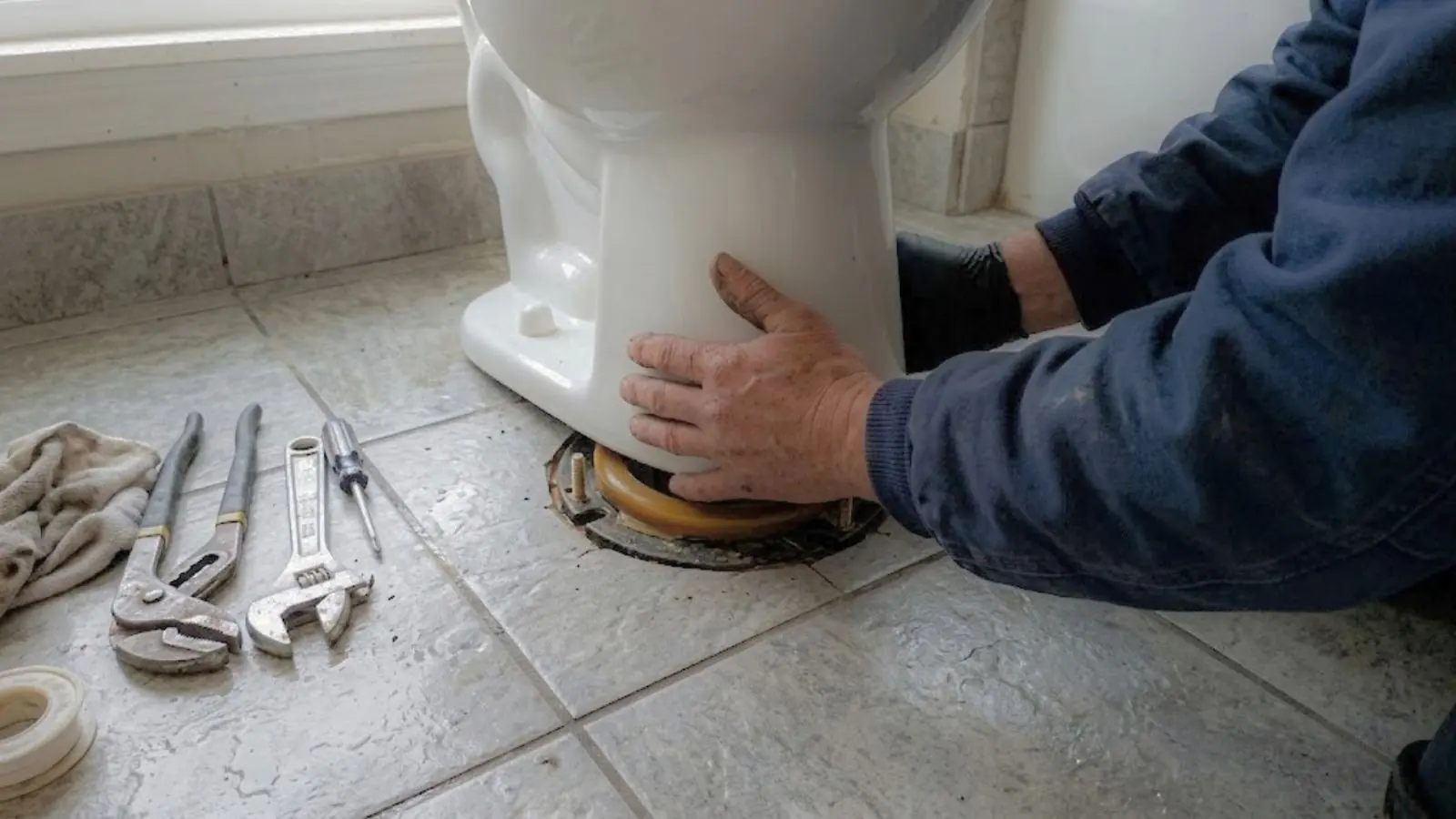
A flange is the ring that connects a toilet to the drain and anchors it to the floor. When it is cracked, rusted, too low or loose, the toilet rocks, the wax seal fails and water or sewer gas escapes at the base. Most flange jobs start with a toilet that will not stay tight.
Before you start: confirm the flange is the problem
A rocking toilet does not always mean a bad flange. Loose closet bolts, an uneven floor or a missing shim can do the same. Pull the toilet and look. A flange with a broken ring, a rusted metal ring, or one that sits below the floor surface needs replacing or repair.
Check the wax ring too. A water stain on the ceiling below, a soft floor at the base, or a faint sewer smell all point to the seal. A wax ring can fail on a perfectly good flange, and it costs far less to replace.
Choosing the right flange for the pipe
The flange must match the drain pipe material and the situation. This table pairs the common choices with when each fits.
| Flange type | Fits | Best for | Watch for |
|---|---|---|---|
| PVC or ABS glue-on (hub) | Cemented over a 3 or 4 inch plastic pipe | New floors and plastic drain lines | Primer and solvent cement must match the pipe plastic |
| Inside-fit (sits in the pipe) | Slides into a 4 inch pipe | Cut pipe that is already in place | A smaller opening than a hub flange |
| Cast iron or brass | Lead and oakum or a mechanical joint | Older homes with cast iron stacks | Corrodes, and the joint is harder to remake |
| Repair ring or flange extender | Sits over a damaged flange | Cracked flange on a good pipe | Should be rated for the job and fastened to the subfloor |
| Offset flange | Shifts the outlet up to 2 inches | A drain that is slightly off the toilet’s center | Reduces the flow area slightly |
Install steps, in order
Cut and clean the pipe
Cut the drain pipe so the flange will sit on top of the finished floor, then deburr and clean the end.
Dry fit and mark
Set the flange without glue, turn it so the bolt slots sit at the three and nine o’clock positions, and mark the pipe.
Prime, cement and set
Brush primer and solvent cement on the pipe and hub, push the flange on with a quarter twist and hold it about 30 seconds.
Fasten and seal
Screw the flange to the subfloor with corrosion-resistant screws, add the closet bolts and set a new wax ring.
Height is where most DIY installs go wrong
The flange should sit on top of the finished floor, not below it. If you tile after setting the flange, the floor rises and leaves the flange recessed. A recessed flange can leave a gap that a standard wax ring cannot fill. The usual fix is a flange spacer or a thicker wax ring, and sometimes a replacement.
Use stainless or coated screws, and set the closet bolts so the toilet’s holes slide over them without forcing the porcelain. Never reuse an old wax ring. Tighten the nuts alternately, a little at a time, so the bowl does not crack. The drain should also slope at least a quarter inch per foot, since a flat waste line slows flow.
Water around the base of the toilet?
Call the 24/7 line. Shut the toilet’s supply valve and keep the bathroom floor dry until a plumber arrives.
What a flange job looks like on a concrete slab or over a crawl space
On a slab, the drain pipe is below the floor. A flange there is cemented to the pipe stub and anchored into concrete with masonry anchors, and the cut often means chipping out around the pipe. On a framed floor, the flange is screwed to the subfloor, and rot around the old fasteners needs repair first. If you can see daylight or soft wood around the drain, the work is no longer a flange job but a floor repair.
In both cases, a broken pipe below the flange changes the scope. A camera can show whether the pipe has cracked, and our sewer inspection page covers when that is worth doing before cutting a floor open.
When not to DIY in Utah
Utah limits what homeowners may do themselves. Under Utah Code 58-55-305, a homeowner’s exemption covers minor repair of a fixture or appliance. It does not cover installing a fixture for the first time, and it does not cover modifying existing piping. A flange swap that involves cutting, extending or re-gluing drain pipe sits close to that line.
Because the wording is narrow, check with the Building Department and the Utah Division of Occupational and Professional Licensing before you cut pipe. If the work involves a new bathroom, a moved toilet or a relocated drain, it is licensed work and usually needs a permit. Our plumbing installation page covers that scope.
You can confirm a plumber’s license on the state’s DOPL lookup. Classifications include Journeyman, Residential Journeyman, Master and Residential Master.
North Salt Lake notes for toilet and drain work
Plumbing permits in North Salt Lake come from the Building Department at 10 E Center Street through the City Inspect portal. The city’s quick-facts sheet says plumbing permits generally need no plan review and lists an over-the-counter fee of $50.50. Inspections run Monday to Thursday.
If you add a toilet or new drain, the South Davis Sewer District (801-295-3469) may require impact fees first, and the city permit does not include them.
Homes from the first wave of building, about 1910 to 1960 west of Orchard Drive, may have cast iron drains and older flanges. Foxboro homes from 2000 to 2010 will mostly have plastic pipe, so a glue-on flange is the usual match there.
Nearby towns we cover
We dispatch from North Salt Lake to Woods Cross and Centerville on the same 24/7 line. Older homes in those towns often need the cast iron or repair ring options in the table above.
Frequently asked questions
On top of the finished floor. If it is flush or below, use a thicker wax ring or a flange spacer, or replace it.
Cutting or changing drain piping usually does, and a like-for-like repair may not. Call the Building Department at 10 E Center Street before you start, since the answer depends on the scope.
The flange may be too low, the floor may be uneven or the closet bolts may be bent. Shimming helps a little, but a flange that sits too low needs a spacer or a new one.
Flanges are anchored into concrete with masonry anchors. Breaking concrete to reach a damaged pipe is work for a licensed plumber, and Utah limits what homeowners may do on existing piping.
Sewer gas and water escape at the base, and the subfloor can rot over time. A stained ceiling below is often the first sign.
The South Davis Sewer District at 801-295-3469. Added fixtures can carry impact fees that are paid to the district before the work, separate from the city permit.