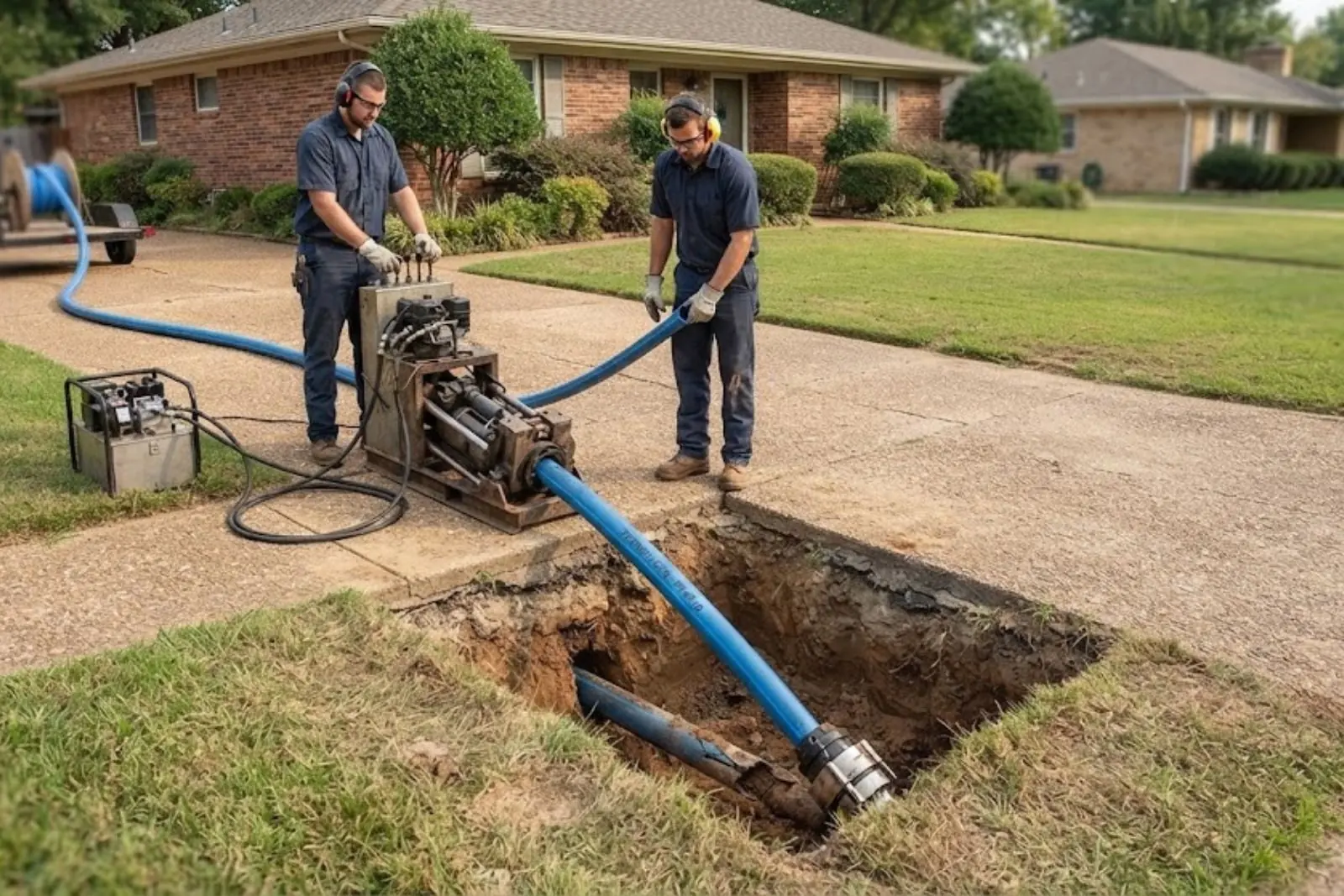
The two main methods are lining the old pipe with a resin sleeve and pulling a new pipe through the old one while the old one breaks apart. A camera inspection decides which one fits, or whether a trench is still the right answer.
How the two trenchless methods work
Lining starts with cleaning the pipe so the sleeve can bond. A felt tube soaked in epoxy is pulled or inverted into the line, inflated against the pipe wall and left to harden. The result is a pipe inside the pipe, with no joints for roots to enter.
Pipe bursting is the other option. A cone-shaped head is pulled through the old line, cracking it outward into the soil while a new plastic pipe follows behind. It needs an entry pit at one end and a pit at the other, usually at the house cleanout and near the street connection.
Both methods leave most of the lawn, driveway and landscaping alone. Neither one is a repair for a pipe that has sagged, because the new or lined pipe follows the old path.
Lining, bursting or digging: which fits
The pipe condition does the choosing, not the sales pitch. Use this table with your camera footage.
| What the camera shows | Likely fit | Why |
|---|---|---|
| Roots at joints, small cracks, rough walls, pipe still round | Lining | A sleeve seals joints and cracks without removing the pipe |
| Collapsed section, crushed pipe or missing pieces | Pipe bursting or dig | A sleeve needs a pipe to bond to |
| Sag (belly) holding standing water | Dig and replace | Trenchless methods keep the same slope, so the low spot stays |
| Several repairs in a short run, heavy deterioration | Pipe bursting | A new pipe replaces the failing one end to end |
| Pipe under a slab or a large tree, with a sound pipe | Lining or bursting | Fewer access points than digging up the slab |
| Offset joint, severe misalignment | Dig at that spot | A liner cannot straighten a shifted pipe |
Does your pipe qualify?
- A camera has run the full length from the cleanout to the main, and you have seen the footage.
- The pipe is round enough that a liner can inflate against it.
- There is no belly. Water does not sit in the pipe after a flush.
- Branch connections, such as a second line joining the main, can be reopened after lining.
- The cleanout is accessible, or one can be installed.
- You know where the lateral meets the district’s main, because the public side is not yours to repair.
What a plumber does before any work starts
Clear the line
Roots and scale come out first so the camera and the liner both see clean pipe.
Scope the full run
A camera records the whole lateral so the cracks, sags and joints are on video.
Pick the method
The footage decides between lining, bursting and an open trench, and you see the reasons.
Test afterward
A second camera pass and a water test confirm full flow before the line is put back in service.
Want a camera on your sewer line?
Call the 24/7 line and describe the backups or slow drains. A licensed plumber can scope the line and explain which repair fits.
What to know about North Salt Lake homes
Sewer service here comes from the South Davis Sewer District (801-295-3469), and the district requires impact fees and its own inspection before a new lateral goes in. If your repair replaces the lateral rather than relining it, ask the district whether fees or an inspection apply before work starts. That one call can prevent a delay on the day the crew arrives.
The Building Department at 10 E Center Street handles plumbing permits through City Inspect, usually without plan review, at $50.50 over the counter. Ask your plumber whether your repair needs one. Utah’s current plumbing code is the 2024 International Plumbing Code (IPC), in force since July 1, 2026.
City design criteria use a 30-inch footing frost depth and an 8 F winter design temperature. That matters for scheduling: an open trench in January is slow to backfill, and trenchless work keeps winter digging small.
Why older neighborhoods lean toward lining
The city’s 2013 General Plan puts the first wave of homes between about 1910 and 1960, west of Orchard Drive and east of Main Street. Sewer laterals from that era were often clay or cast iron. Both pipe types roughen with age, and roots enter at the joints.
If you live in that part of town, a camera inspection is the sensible first step. Often the pipe is still round, only cracked and rooted, and that is where lining earns its place.
Foxboro was built between 2000 and 2010. Its laterals are mostly plastic and rarely fail from age. A problem there usually points to a single bad joint, a sag from settling or damage during construction, so a spot repair is more likely than a full liner. The same dispatch line covers neighbors in Woods Cross, where many homes are newer still.
What changes the price
Without a camera, nobody can quote trenchless work honestly. These factors move the number:
- The length of pipe to be lined or replaced.
- The pipe diameter and how many bends it has.
- How many access pits are needed, and whether the cleanout exists.
- Surface restoration, such as concrete or landscaping at the pits.
- Permit and district fees if a new lateral is involved.
Homeowners insurance usually covers sudden and accidental damage, not wear and tear on a sewer line. Ask your insurer whether a line coverage endorsement is on your policy.
When trenchless is the wrong answer
We tell you when a trench is the better choice. A collapsed pipe, a deep belly or a lateral with repeated misaligned joints will not be fixed by a sleeve. Digging at that spot and replacing the section is cleaner than lining over a defect.
If roots are the only problem, regular sewer line cleaning may buy years before any repair. Lining also does not repair the public main. If the camera shows the problem past your property line, the sewer district is responsible, and a plumber can show you the footage so you have proof. For the full picture of options, see our sewer line repair service page. Homes near Bountiful get the same camera-first approach.
Frequently asked questions
Lining and bursting often take one day once the line is cleaned and scoped, with a longer day if the pipe is long or the resin must cure. Cleaning and the camera run can be the same day or earlier. Your plumber should give you a schedule after seeing the footage.
Much less than a trench. You lose a small area at each access point, but the rest of the yard, the driveway and any mature trees stay in place.
It depends on whether the work replaces pipe or relines it. Plumbing permits go through the Building Department at 10 E Center Street, and the South Davis Sewer District has its own fees and inspection for new laterals. Ask both before work begins.
No. A liner needs a pipe to attach to. A collapsed section needs bursting through it, or a short dig to replace that section.
A camera run shows where the blockage or damage sits relative to the cleanout and the connection. The district handles the main, and you handle the lateral to your house.
It is more likely to have clay or cast iron laterals, which roughen with age and let roots in. That is a general pattern, not a guarantee, so a camera is the only way to know about your own line.